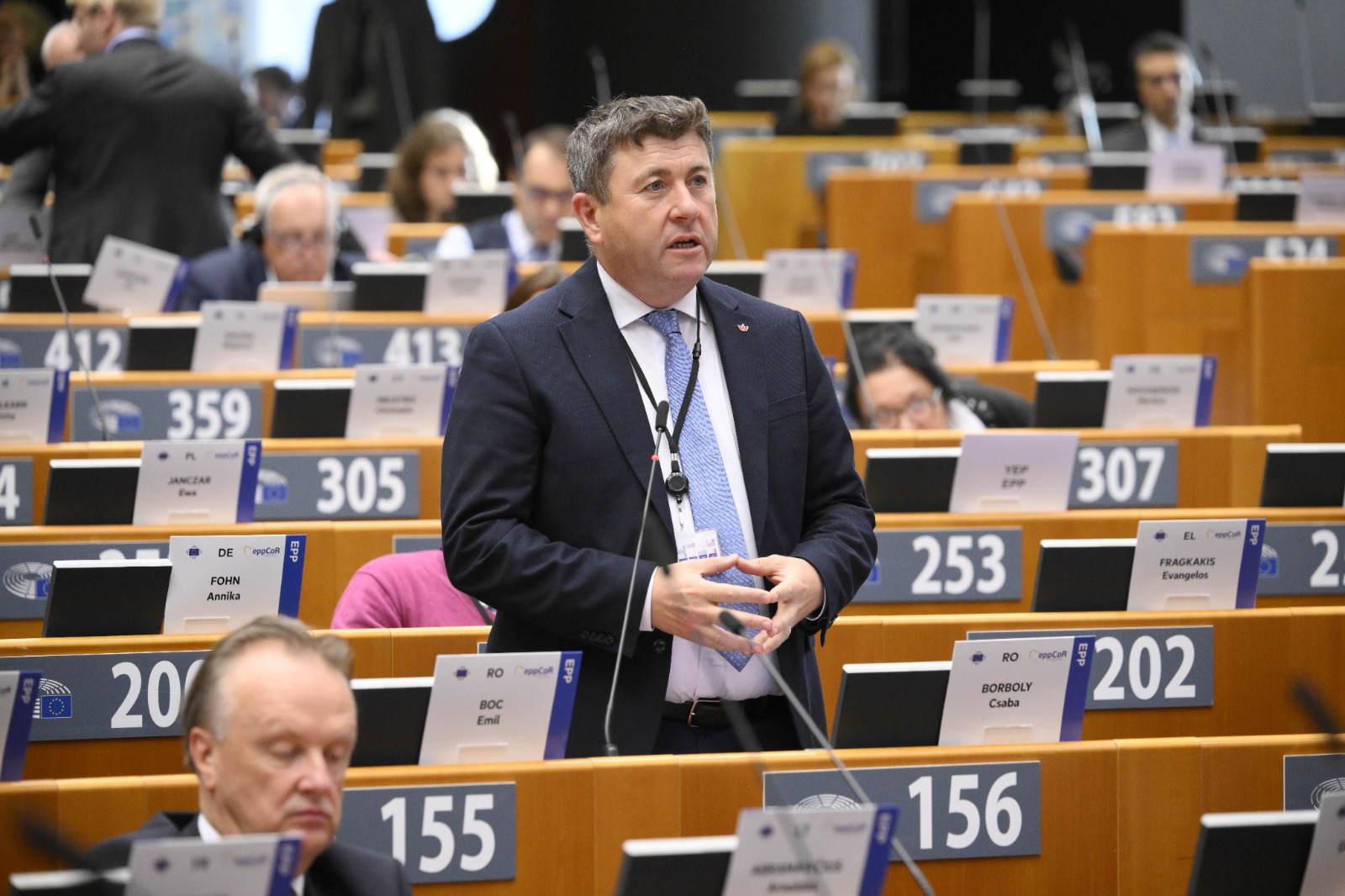
At today’s plenary session of the European Committee of the Regions, the message was clear: environmental policy must be judged not only by ambition on paper, but by whether it can be implemented in real life across all territories.
This is why the intervention focused on two essential principles. First, decisions must be based on clear and reliable data. Second, simplification must not mean deregulation. It must mean clarifying obligations so that environmental policies can actually be implemented and complied with in everyday administrative, social and territorial reality.
The rapporteur explicitly thanked colleagues for the collective work and for the amendment proposals that helped improve the text. That matters. It shows that cooperation across political lines and across regions can bring concrete results, especially when local and regional realities are brought seriously into the European discussion.
Why this matters for the European Union
Across Europe, there is a real risk of creating a two speed implementation landscape. Better resourced territories can comply more easily, while rural, mountain, eastern and structurally constrained regions face higher burdens with fewer tools. That is neither fair nor sustainable.
The debate also highlighted the importance of biodiversity policy being socially workable. In regions affected by large carnivores, environmental policy must include prevention, fair compensation, rapid response, science based monitoring and meaningful local involvement. Human life and safety must be treated as a priority in every territory.
Communities living and working in high nature value areas are not obstacles to conservation. They are the people who have maintained these landscapes over generations. If they lose trust, the implementation gap will grow. If they are treated as partners, Europe’s environmental goals become stronger.
Where this report will matter next
This report will matter in the next phase of European policy shaping. It will feed into wider discussions on environmental implementation, simplification, biodiversity governance and the preparation of future EU financial priorities.
That means it matters not only for today’s debate, but for the design of future support systems, funding logics and implementation approaches. It is especially relevant for regions that want a stronger territorial voice in the next European cycle.
A more united Europe requires practical solidarity between East and West, between urban and rural territories, and between political ambition and real delivery. That is how common European values can be upheld across the whole Union.