
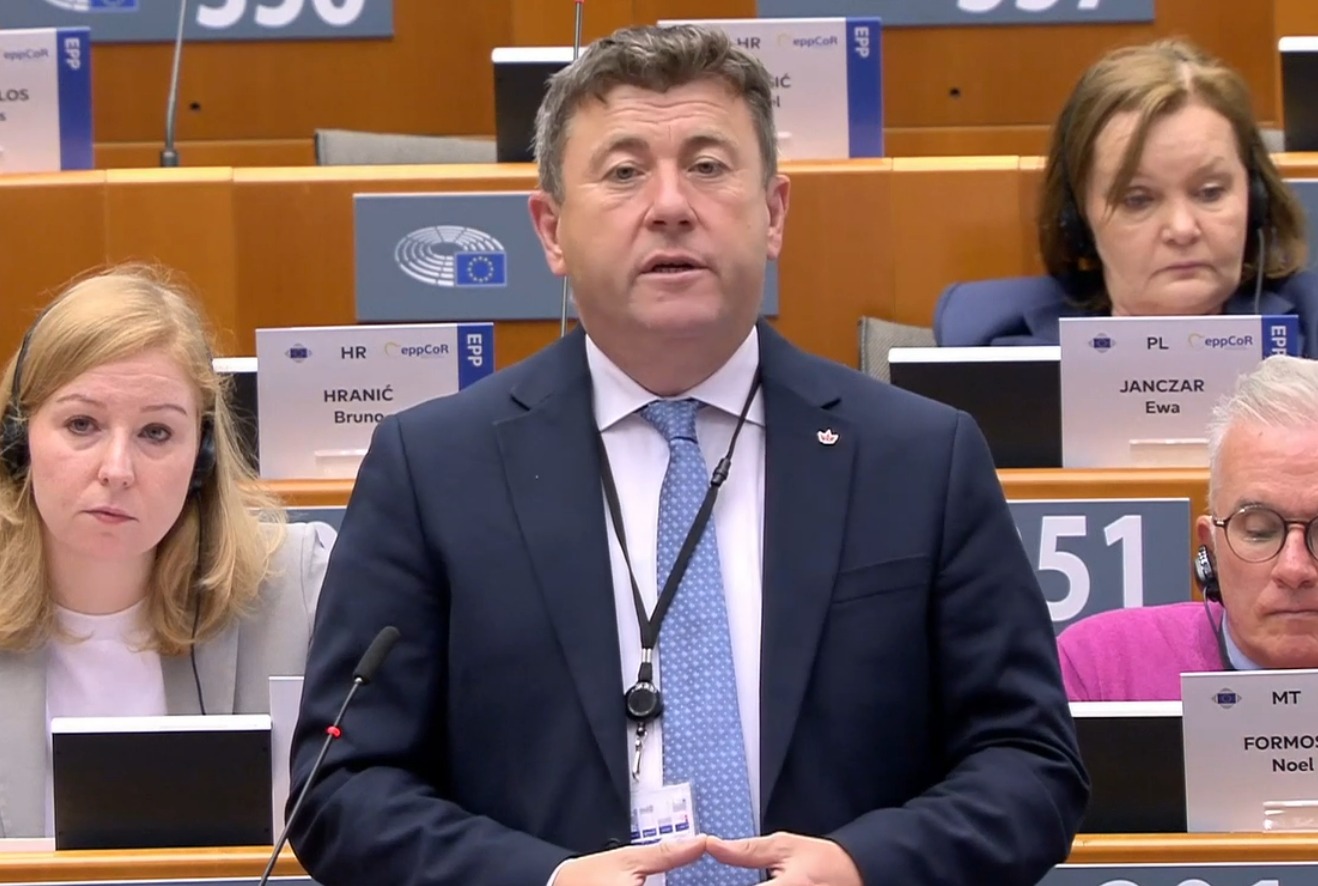
Today in Brussels, I spoke at the meeting of the Commission for Economic Policy (ECON) of the European Committee of the Regions during the debate on the Industrial Accelerator Act. This proposal will shape where Europe’s new industrial investments are made, how quickly permits are granted, who can access public procurement and which regions can keep their young people and skills.
My message was simple: there cannot be two Europes. We cannot accept a Union in which some regions attract investment, knowledge and quality jobs, while others lose their workers, their young people and their intellectual capacity. If European industry accelerates, it must accelerate everywhere, not at the expense of less-developed regions.
A shared European challenge
The Commission presented the proposal in March 2026 to strengthen the competitiveness, resilience and decarbonisation of European industry. Manufacturing remains the EU’s largest employer, yet its share of EU GDP fell from 17% in 2000 to 14% in 2024. The proposal introduces faster and digital permitting, single points of contact, industrial manufacturing acceleration areas, European preference in public procurement and conditions for foreign investment.
These are the right objectives. But Europe’s competitiveness is built in all its regions, not only in its strongest industrial centres. If acceleration benefits only those already ahead, it will deepen the gap between East and West, between urban centres and rural areas, and between core and periphery. That would weaken the Single Market and the cohesion on which the European project rests.
Three concrete proposals
Together with my team, I prepared three precise amendments and forwarded them to Member of the European Parliament Iuliu Winkler, who agreed to table them and to defend the regional perspective in the parliamentary negotiations.
First, faster permitting requires capacity. Member States should ensure that permitting authorities have adequate administrative, technical, financial and digital capacity, with technical assistance, training and the sharing of expertise, and particular attention to regional and local authorities.
Second, industrial manufacturing acceleration areas should be designated in cooperation with regional and local authorities, which know local labour markets, infrastructure constraints and business needs.
Third, before such areas are designated, their territorial, economic and social impacts should be assessed, including effects on neighbouring and non-designated regions, with particular attention to less-developed regions, regions in transition and regions facing demographic challenges. Where significant adverse effects are identified, mitigating or complementary measures should follow.
During the debate, I also kindly asked our guest to support a stronger regional dimension in the European Parliament’s report. The European Economic and Social Committee has made a similar point, stressing that regional disparities must be taken into account when acceleration areas are designated.
Bringing East and West closer
Europe’s strength lies in shared values: solidarity, fairness, partnership and respect for every community. Industrial policy must reflect these values. The next EU budget for 2028–2034 will shape the future of the generation now entering adulthood. It must give young people a real choice to stay, work, build families and create businesses where they grew up.
That is why regions must not merely implement EU policy, but help design it. Real multilevel governance, place-based solutions and genuine access to opportunities are the way to bring Europe’s East and West, its cities and its rural areas, closer together. Industrial acceleration will only be a European success if it is also territorially fair.