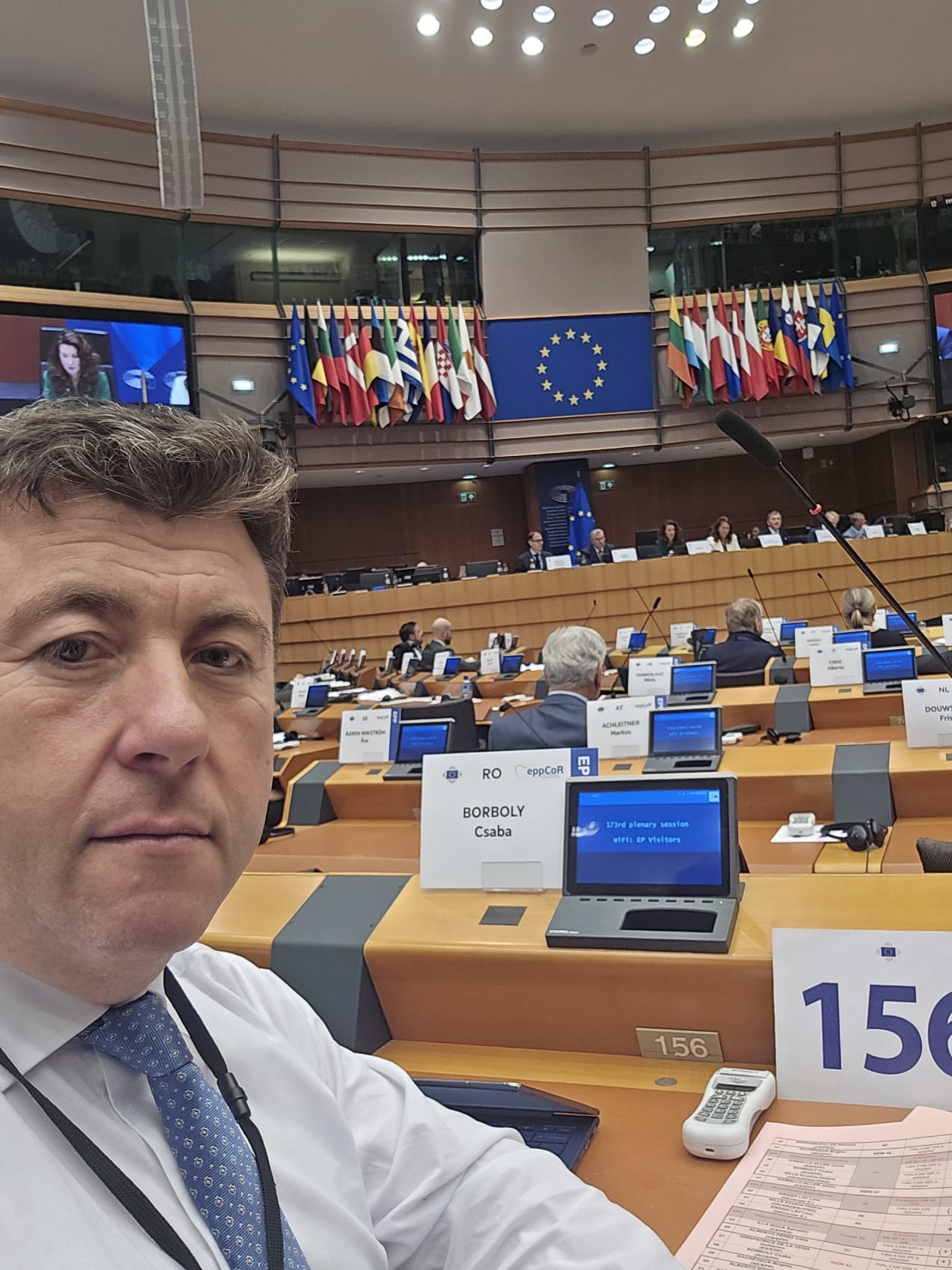
Europe’s bioeconomy will be stronger if communities help shape it, rather than merely supply its resources. This is the principle behind my preparatory work on the European Committee of the Regions opinion on a strategic framework for a competitive and sustainable EU bioeconomy, on the agenda of the current plenary session.
My concrete contribution in this dossier is amendment AM 9 to point 18. It calls for county authorities and equivalent intermediate levels to be explicitly recognised as key implementing partners. It also calls for dedicated consultation mechanisms so that their operational experience informs the design of future coordination platforms and investment instruments.
This is not a request for a special exception for one territory. It addresses a shared European challenge: connecting ambition with delivery across very different local economies.
Competitiveness needs territorial knowledge
The bioeconomy connects renewable biological resources, knowledge and innovation with products, services and economic activity. It offers an opportunity to strengthen European competitiveness while supporting responsible resource use and local prosperity.
Yet a promising technology reaching the market depends on more than research. It needs reliable partnerships, viable supply arrangements, skills, investment preparation and communities able to participate.
County authorities and equivalent bodies can help connect municipalities, producers, businesses, research institutions and advisory services. Their role is not to replace enterprise or scientific expertise. It is to bring complementary capabilities together and ensure that territorial conditions are understood early.
Point 18 already calls for structured involvement of local and regional authorities in the governance and implementation of the EU Bioeconomy Strategy. AM 9 makes the intermediate level explicit and seeks a dedicated route for its implementation experience to inform future structures.
Why preparatory work matters
European representation includes analysing draft texts, preparing amendments and building an argument that can attract support across Member States. Professional preparation and political dialogue matter because a territorial concern becomes stronger when it is understood as a common European challenge.
The objective is not simply to secure a reference to an institution. It is to improve the connection between policy design and practical delivery. Consultation can identify obstacles before they undermine a project and reveal partnerships that might otherwise remain invisible.
An opinion is not a funding award. A submitted amendment is not the same as an adopted outcome. AM 9 seeks stronger participation in shaping future arrangements, not an automatic entitlement to investment.
One Union, not separate tiers of opportunity
Eastern and western Europe bring complementary strengths. Rural, mountain and remote communities across the Union can nevertheless face similar difficulties in connecting local resources with research, processing capacity and markets.
The response should not be a contest between east and west. It should be better cooperation between them. Research partnerships, business links and cooperation between territories can connect capabilities that are less effective in isolation.
A successful European bioeconomy should generate opportunities both for communities supplying resources and for those developing and marketing technologies. Industrial scale, local jobs, skills and business participation should be considered together.
European added value lies in creating connections that individual territories cannot build alone. Cohesion is not an alternative to competitiveness. It helps more territories contribute to it.
Preparing for the next European budget
The proposed financial framework for 2028 to 2034 gives this debate a longer horizon. National and regional partnership plans are central to the proposed architecture, while final rules remain under negotiation.
Bioeconomy policy and budget negotiations are distinct processes. They nevertheless raise a common question: how can European priorities respond better to the places where implementation happens?
Territorial actors should prepare credible proposals now, identifying real needs, committed partners, viable operating arrangements and measurable outcomes. National authorities should engage with these proposals early rather than treating consultation as the final administrative step.
The purpose is not to promise that every project will receive funding. It is to ensure that strong proposals from less visible territories have a fair opportunity under the rules eventually adopted.
What the next generation inherits
Young people entering adulthood today will live with the consequences of the investments and institutions being shaped now. They will inherit not only infrastructure, but also the quality of cooperation between public authorities, businesses and communities.
Trust, mutual respect and the willingness to work together are part of that inheritance. They are also practical conditions for a functioning European Union.
My preparatory work and AM 9 are directed towards a bioeconomy that combines competitiveness with cohesion, and European ambition with local knowledge. A Union that listens across its territories is better equipped to innovate, invest and deliver together.