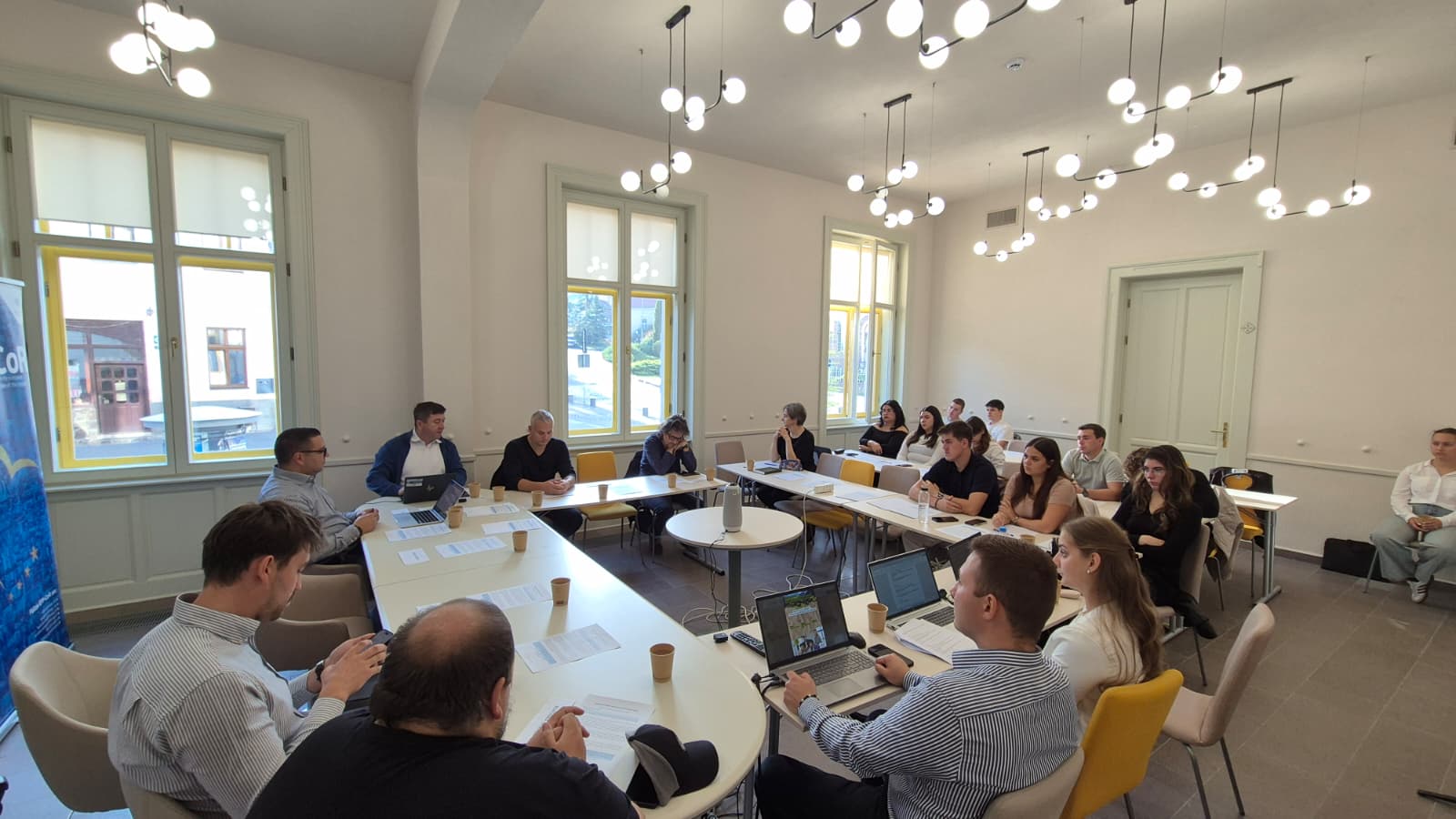
The meeting, entitled “Staying, Returning Home, Building a Future”, brought together young people, local government representatives, professionals, employers and youth organisations to discuss what conditions need to be created so that staying in the region or returning home can become a genuinely free and attractive choice.
The dialogue was attended by Csaba Borboly, Vice-President of Harghita County Council and Member of the European Committee of the Regions; Béla Bors, Deputy Mayor of Miercurea Ciuc; László Bara, President of the Ciuc Area Youth Council (CSTIT) and Deputy Mayor of Plăieșii de Jos Commune; Tiberiu Pănescu, Executive Director of the Harghita County Employment Agency (AJOFM Harghita); Dezső Sorin Márk, President of the Harghita County branch of Patronatul Român; Sándor Koronka, representative of the Harghita County Directorate for Sport; and Dr Orsolya Gergely, sociologist and Associate Professor at the Miercurea Ciuc Faculty of Sapientia Hungarian University of Transylvania. Pasted text
Coming from different fields, the participants examined the same question from different perspectives: what is needed for young people in Harghita County to see a genuine future in education, employment, independent living and starting a family?
The discussion highlighted that youth out-migration cannot be treated simply as a youth policy issue. Housing, first employment, professional experience, retraining, transport, entrepreneurship, community life and the conditions for starting a family are closely interconnected.
Participants also agreed that European mobility should not be restricted. Studying and gaining professional experience abroad can be valuable. The aim should be to ensure that leaving is not a necessity, that returning home is a realistic option, and that staying does not mean giving up opportunities. Pasted text
The right to stay must be at the centre
In his contribution, Csaba Borboly placed the right to stay at the centre of the discussion. He stressed that housing and quality employment are both essential, but neither is sufficient on its own. The needs of Harghita County must be identified and formulated in time so that they can be reflected in Romanian and European planning for the period after 2028.
“Mobility is a European opportunity, but forced out-migration is a form of territorial inequality. The objective is not to tell young people not to leave. We need to make sure they have reasons to return home and that they also have a genuine choice to build their future here,” Csaba Borboly emphasised. Pasted text
He added that the county’s role should not be to produce yet another general strategy, but to connect the experience of municipalities, young people, businesses, civil society organisations and the research community. For the next European budgetary period, Harghita County needs concrete and implementable proposals based on real local experience.
Young people need more than jobs – they need a liveable environment
Béla Bors, Deputy Mayor of Miercurea Ciuc, stressed that retaining young people requires a liveable city. Employment matters, but so do housing, the environment in which young people can start a family, leisure opportunities, community life and the quality of life available to children.
He presented housing developments in Miercurea Ciuc and the preparation of the city’s industrial area, underlining that major investments require long preparation and implementation periods. For this reason, work on the projects needed in the next funding period must begin now.
László Bara drew attention to the differences between settlements located close to urban centres and more remote mountain villages. In rural areas, inheriting a house or land can be a considerable advantage, but this alone is not enough to keep young people at home if suitable jobs, transport, services or community life are missing.
He also noted that many young people do not necessarily choose a career that matches their interests, but instead continue with the livelihood opportunities already available locally. Pasted text
First employment, experience and lifelong learning
Tiberiu Pănescu highlighted the importance of finding a balance between employees’ expectations and the capacity of the local economy. A decent income is a legitimate expectation, he said, but its sustainability also depends on business productivity, market opportunities and employers’ ability to pay.
He also emphasised the importance of lifelong learning. Schools and universities provide a foundation, but successful integration into the labour market requires continuous skills development and practical knowledge.
Mobility should also not be understood exclusively as moving abroad. Commuting within the county or temporary accommodation closer to a workplace can also help young people access employment opportunities. Pasted text
Dezső Sorin Márk highlighted three basic expectations from the employers’ perspective: punctuality, openness and willingness to learn. Young people do not need to know every internal company process in advance, but they must be prepared to learn the specific requirements of the workplace.
For smaller businesses, however, training can present an additional challenge because it is often difficult to release employees from their daily work. Future programmes should therefore take into account not only training costs but also lost working time and organisational difficulties.
Young people should also be reached through other young people
Sándor Koronka drew attention to the difficulty of reaching young people. The lifestyles presented in the virtual space can often create unrealistic expectations, while participation in local communities and the social recognition of vocational skills are weakening.
One concrete proposal was to involve active young people in reaching their peers. In many cases, young people themselves can communicate more credibly with those who do not attend institutional events or use traditional information channels. Pasted text
Returning home is about more than salary
Dr Orsolya Gergely stressed that youth migration is not a uniform phenomenon and therefore cannot be addressed with a single solution.
The situation of a person who works abroad for several months but continues to live primarily at home is different from that of a student attending university elsewhere in Romania, and different again from that of someone who has settled in Western Europe for the long term.
Among university graduates, migration may be influenced by an unsuccessful first attempt to enter the labour market, the absence of innovative working environments and inflexible institutional structures.
At the same time, salary is not the only factor that matters when deciding whether to return. Family, landscape, the mother tongue, cultural environment, friendships and a sense of belonging are major strengths of Harghita County. But they can only become genuine factors in retaining or bringing back young people when they are combined with adequate employment, housing, transport, internet access and public services. Pasted text
Gaining the first experience remains one of the biggest barriers
The contributions from young participants revealed several clear real-life challenges.
One of the most significant obstacles for young people entering the labour market is that professional experience is often required even for a first job. This creates a difficult cycle: without experience there is no job, but without a job there is no opportunity to gain experience.
Participants therefore proposed that future programmes should treat paid internships, workplace mentoring and first employment as parts of one connected pathway.
Retraining also emerged as an important issue. Some young people graduate in fields where there are no suitable employers in Harghita County, while others realise only after completing their studies that they would prefer a different career.
In these cases, another full university degree may not be necessary. Shorter professional, digital or entrepreneurial training courses aligned with employers’ needs could provide a more effective solution. Pasted text
The challenges are not the same everywhere
The dialogue made it clear that there are significant differences even within Harghita County. A young person living in Miercurea Ciuc faces different challenges from someone living in a nearby village, in the Kászon area or in the Ghimeș region.
In rural areas, young people may already have access to a house, land or a family farm, while lacking employment suited to their profession, adequate transport, services or access to markets.
Mobility within the county is another weak point. Poor connections between home and workplace can contribute to out-migration even when suitable employment is available elsewhere within Harghita County. Pasted text
Three concrete next steps
The dialogue identified three main directions for follow-up.
First, a short, evidence-based assessment should be prepared to identify where young people in Harghita County face the greatest barriers in accessing first employment, housing, transport, training and services.
Second, participants proposed preparing one feasible county-level pilot initiative. Under the working title “First Experience Harghita”, the initiative would connect short training programmes tailored to employers’ needs with paid professional experience, workplace mentoring and, where necessary, support for travel or temporary accommodation.
At this stage, the initiative is not a funding commitment. Its target group, employer demand, operational model and potential financing sources must first be clarified.
Third, the agreed proposals could be developed into a package for national and European advocacy.
At national level, the proposal would be to ensure that the needs of young people in rural and mountainous areas are specifically reflected in the next National and Regional Partnership Plan.
At European level, the objective will be to ensure that the specific situation of rural, mountainous and minority-inhabited regions is taken into account in the 2028–2034 EU budgetary period, and that local and regional actors are genuinely involved in planning. Pasted text
“Young people are not asking for more programme names. They want a first opportunity, a predictable start in life, the possibility to learn and change careers, accessible housing, functioning transport and a community where their knowledge and initiative have a place. Harghita County’s strengths are family, the mother tongue, community, cultural attachment and a human-scale way of life. The task for the coming period is to complement these strengths with real economic opportunities and accessible services,” Csaba Borboly said. Pasted text
The key conclusion of the meeting can be summarised simply: out-migration should not be stigmatised. What must be created is the freedom to stay and the freedom to return home.