Europe cannot build a strong maritime economy on a weak territorial foundation. Ports, shipyards and shipping companies do not operate in isolation. They depend on materials, components, energy, skills, research, digital services and transport connections from regions across the continent.
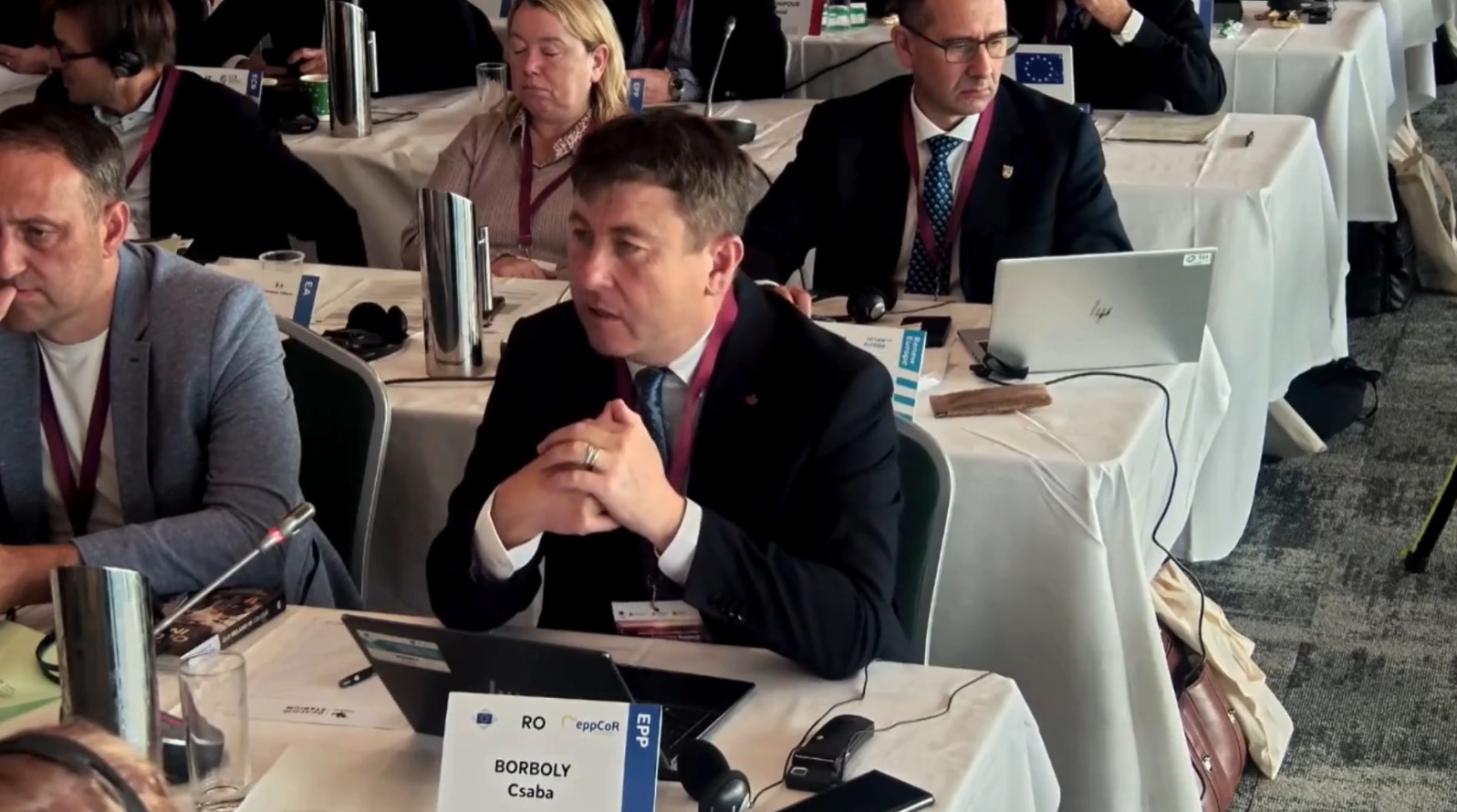
Csaba Borboly delivered this message in Galway during the meeting of the Commission for Economic Policy (ECON) of the European Committee of the Regions, in the debate on the EU Industrial Maritime Strategy.
The discussion produced a concrete result: colleagues supported his proposal that the strategy should also recognise inland, rural and mountain regions connected to maritime value chains. They also backed the principle that the territorial effects of new rules should be assessed and that incentives and economic benefits should not be concentrated only in major ports and established coastal industrial centres.
“The number of accepted amendments is not the main point. What matters is the substance that has entered the common European position and the opportunities it can create for inland and eastern regions,” Borboly Csaba stressed.
The European maritime sector is important for trade, security, industrial capacity and the green and digital transition. These are European priorities, not only coastal priorities.
The risk of two Europes
If European policy focuses only on major ports and established industrial centres, public funding, private investment and quality jobs risk remaining concentrated in regions that are already among the strongest.
This could deepen the divide between regions that design projects and attract capital, and those that provide labour, materials and markets but receive only a limited share of the added value.
Europe cannot expect its eastern, rural and mountain regions to contribute to common objectives while leaving them outside new industrial opportunities.
The answer is not to reduce support for coastal and island regions. Their needs are real and must be addressed. The objective should instead be to create stronger links between maritime hubs and the wider European territory.
“A port should be a gateway for development, not the point where development ends,” Csaba Borboly said.
This is also a question of European values. Cohesion means that geography should not determine who can participate in progress. Solidarity means creating the capacity to contribute, while partnership means involving local and regional authorities in policy design rather than only asking them to implement decisions taken elsewhere.
The rapporteur reinforced the territorial approach
In his closing remarks, the rapporteur referred to the example of his own inland and predominantly agricultural region. He stressed that the development of export-oriented production depends on good rail and transport connections to the sea.
This reinforced the argument that maritime policy is not exclusively a coastal matter. It directly affects market access, investment opportunities and employment in inland regions across Europe.
Economic life does not end at the coast.
What entered the European position
During the debate, Csaba Borboly succeeded in gaining support for two essential points concerning inland and eastern regions.
The accepted proposal calls for an approach based on local conditions that also recognises inland, rural, mountain, peripheral and border regions connected to maritime value chains.
Stronger rail, road, inland waterway, energy and digital connections should link ports and coastal industrial centres with their wider hinterlands. Local small and medium-sized enterprises, workforce skills and related infrastructure should also be taken into account through territorial impact assessments.
Csaba Borboly will continue to advocate for transparent territorial criteria, dedicated technical assistance and partnerships between regions. Such partnerships should connect ports with inland production sites, rural and mountain businesses, research institutions and skills providers.
Formal eligibility for funding is not enough if smaller actors lack the staff, financing or project-development capacity required to participate.
Colleagues also supported the proposal that future regulatory and taxation frameworks should assess their different territorial impacts. New rules should avoid creating disproportionate costs for local authorities and small businesses, while incentives and economic benefits should not be concentrated in only a limited number of major ports and established coastal centres.
These proposals do not diminish the importance of maritime regions. They strengthen the strategy by giving it a broader and more resilient European foundation.
What this can mean in practice
An inland region does not need a shipyard to contribute to Europe’s maritime industry.
Local companies may supply processed materials, mechanical components, maintenance services, software, logistics tools or clean technology solutions. Vocational schools can train workers for new industrial needs, while universities and research centres can participate in projects involving advanced materials, circular production, energy efficiency, automation and artificial intelligence.
This is relevant for counties and municipalities in Romania, but also for similar territories throughout Central and Eastern Europe.
Better connections to the Black Sea, the Danube, the Baltic and Adriatic regions, as well as to major European transport corridors, can create new markets for local companies. Cooperation with ports and maritime clusters can also open research, training and business opportunities far from the coast.
However, these benefits will not emerge automatically.
Regions need clear strategies, capable institutions and prepared projects. Small businesses require technical support, simpler procedures and realistic access to financing. Education and training providers need direct links with employers and European innovation networks.
European instruments supporting research, innovation, transport, cohesion and investment can contribute to this transformation. The central question is where the resources will actually go.
If funding calls are designed mainly for very large projects and already strong consortia, weaker regions may remain eligible in theory while being excluded in practice.
Political work beyond one mandate
European policy must also look beyond the next election cycle.
Some partnerships created today may only produce their full results in five, ten or fifteen years. This does not make the work less important. On the contrary, it makes early involvement essential.
Political responsibility is also about what is left for those who come next: trusted partnerships, professional cooperation, respected arguments and European partners who understand the realities of the region.
A short intervention or an amendment is only the visible part of this work. Behind it stand technical preparation, political dialogue and the search for allies from regions facing similar challenges.
The strongest proposals start from a local reality but offer a European solution. Connecting maritime and inland value chains can bring together coastal, island, rural, mountain, western and eastern regions around a shared interest. It can strengthen European competitiveness while making territorial cohesion more concrete.
One Europe through cooperation
The European Union is reshaping its industrial, transport and investment policies. This creates an important opportunity for local and regional authorities to influence how future programmes are designed.
Partnerships between ports, inland regions, businesses, training providers and research institutions should be developed before funding calls are published. Joint projects must be prepared early, and Europe should make use of the skills and productive capacity of all its territories.
“There must not be one Europe that designs and benefits, and another that waits and supplies low-value inputs. A competitive and resilient Union needs both east and west, coast and inland, large industrial hubs and smaller communities,” Csaba Borboly underlined.
Economic life does not end at the coast. European opportunity should not end there either.