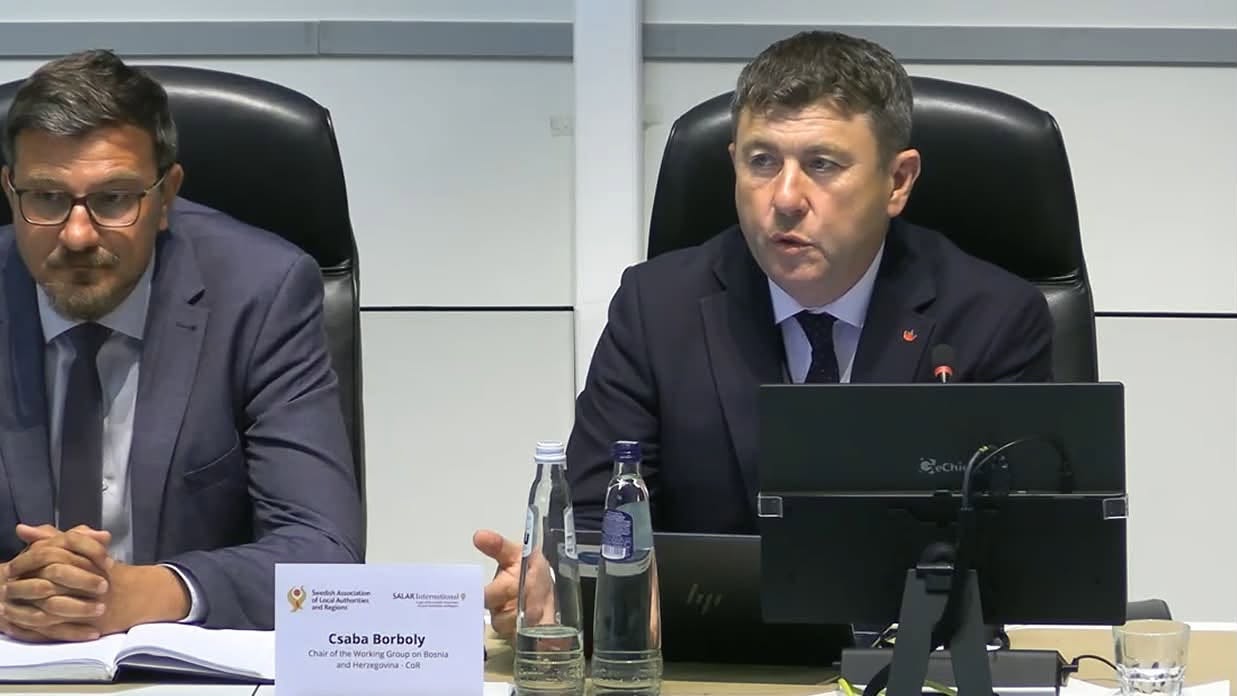
Today I took part in a high-level seminar at the European Committee of the Regions, organised by SALAR International — the international arm of the Swedish Association of Local Authorities and Regions — on the theme: “Preparing Locally for EU Accession: Impact Assessments, Reform Agendas and Local Readiness in Bosnia and Herzegovina, Moldova, North Macedonia and Ukraine.”
The seminar brought together local elected representatives from candidate countries, EU officials from DG Enlargement, researchers, think tanks, the Council of European Municipalities and Regions, and members of the Committee of the Regions. The conversation was substantive, honest, and — at times — uncomfortable.
The Uncomfortable Truth About EU Enlargement
More than 70% of EU legislation is implemented at the local and regional level. This figure, long used by the Committee of the Regions, reflects a fundamental reality: European policy only becomes meaningful when a municipality builds the infrastructure, runs the service, manages the investment, or informs the citizen.
And yet, in most accession processes, local and regional authorities are among the last to be consulted — if they are consulted at all.
This is not a procedural detail. It is a structural flaw with long-term consequences.
What Happens When You Exclude Local Authorities From Accession
There is an instructive and cautionary case from an existing EU member state. When accession happened without adequate involvement of local authorities in the reform design, the result was years of uneven implementation — and in some sectors, the answer was recentralisation.
In the water and wastewater sector, for example, individual municipalities lacked the administrative and financial capacity to comply with EU environmental standards. Services were reorganised into regional operators — not as a planned reform, but as an emergency response to a capacity gap that had not been addressed before accession. In 2026, the consequences of those decisions are still being felt.
The lesson is clear: accession preparedness is not only a national task. It requires empowered, resourced, and genuinely involved local and regional authorities — before the decision is made, not after.
Moldova Is Showing the Way
What gives reason for optimism is that some candidate countries are choosing a different path. Moldova, in particular, is actively involving its local and regional authorities in the accession process — treating them as partners in reform design, not just as implementers of outcomes negotiated elsewhere.
At today’s panel, representatives from Moldova’s local government network and its Bureau for European Integration described a process of structured local consultation and capacity-building that stands in contrast to earlier accession experiences. This model deserves recognition and replication.
What This Means for the EU’s Enlargement Agenda
The discussion today pointed to three structural priorities that must shape how the EU approaches enlargement in the years ahead:
- Local inclusion before accession, not after. Candidate countries must involve local and regional authorities in designing the reform agendas they will ultimately be responsible for delivering.
- Capacity-building as a pre-condition, not an afterthought. EU pre-accession instruments — and the post-2027 Multiannual Financial Framework — must be designed with local administrative capacity as a primary concern.
- A Cohesion Policy that does not retreat. Enlargement must not come at the expense of regions in current Member States that still face significant development challenges. Solidarity is not a zero-sum game.
The Broader Point
The European project is delivered locally, every single day. Its credibility — with citizens, with communities, with the regions that feel left behind — depends on whether local and regional authorities are genuine partners in shaping it, or merely the last link in a chain of decisions made elsewhere.
Enlargement is one of the EU’s most consequential tools for geopolitical stability, democratic consolidation, and long-term prosperity. Making it work requires getting the local dimension right — from the beginning.
That is the work being done today, in seminars like this one. And it matters.
Csaba Borboly, Vice-President of Harghita County Council, Chair of the CoR Working Group on Bosnia and Herzegovina, Member of the European Committee of the Regions