
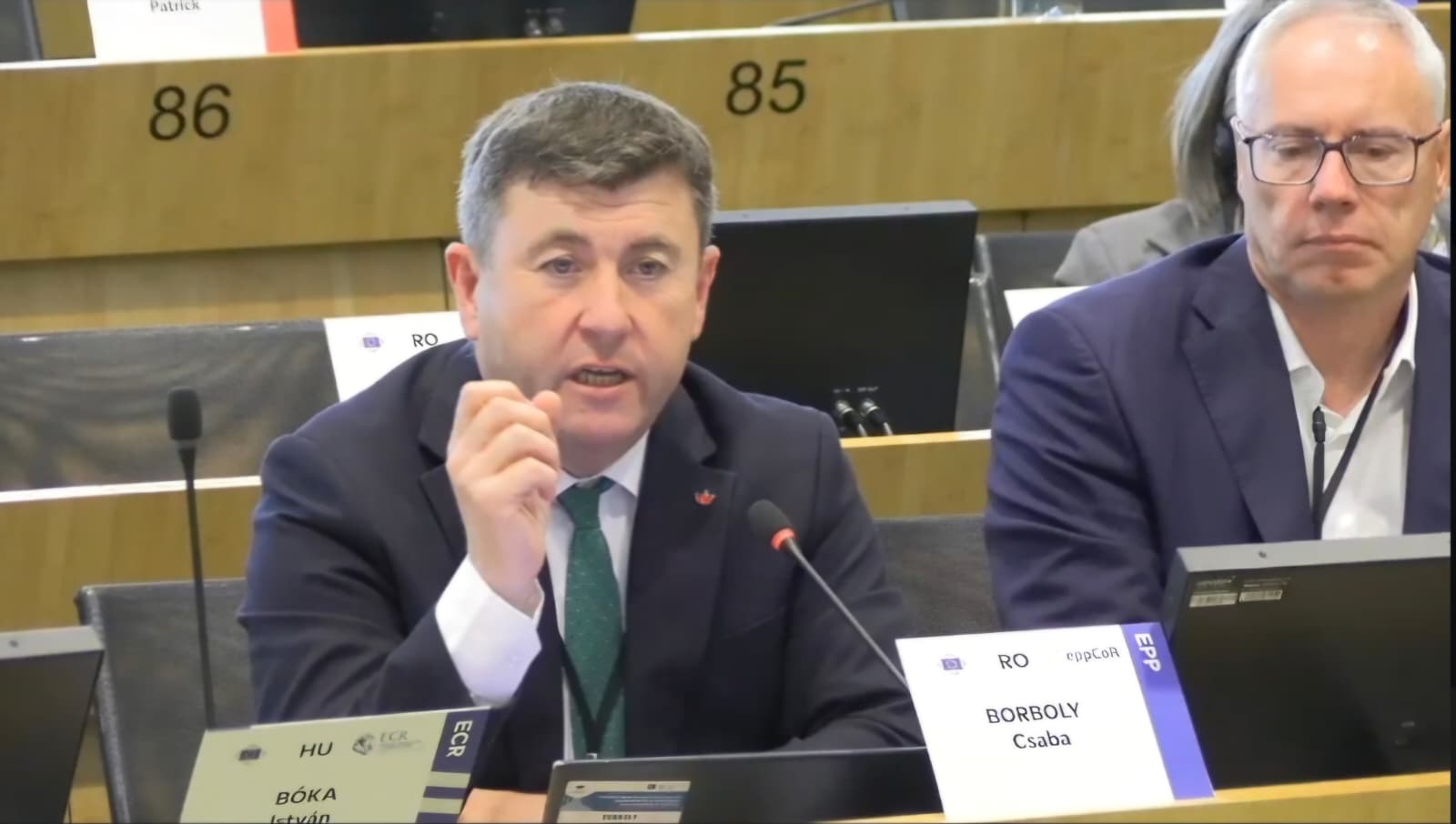
During the debate in the ENVE Commission of the European Committee of the Regions, I made it clear: in Harghita County, the bear issue is no longer only a matter of nature conservation or agriculture. It is about the safety of people living in our towns and municipalities.
According to the report of the Harghita County Gendarmerie Inspectorate, between the beginning of 2026 and 22 September, 466 calls were made to the 112 emergency number reporting bears near inhabited areas. During the same period in 2025, there were 226 such reports.
This does not mean 466 different bears, but it does mean that the number of alerts has more than doubled.
This is not a theoretical debate. This is not a joke. The problem is getting worse.
Protection must work
As rapporteur of the European Committee of the Regions opinion on large carnivores, adopted in 2024, I stressed that we are not arguing against nature conservation. We want a healthy bear population, safe communities and social cooperation.
According to the opinion adopted by the European Committee of the Regions:
- the protection of human life and health must be given priority;
- the conservation status of species must be reviewed regularly on the basis of scientific data;
- differences between regions in terms of population size and conflict levels must be taken into account;
- prevention, compensation, rapid intervention and population management must be applied within an integrated system;
- local and regional authorities must be given not only a consultative role, but also a genuine role in implementation.
A species may be rare and vulnerable in one part of Europe, while in another region there may be a high-density population in favourable conservation status that causes persistent public-safety conflicts.
The same practical management system cannot provide an adequate response everywhere.
Local knowledge remains on paper
In Harghita County, we operate a regional platform where local authorities, experts, farmers, hunting managers and other stakeholders sit around the same table. We know where conflicts occur, we collect data and we formulate concrete solutions.
The problem is that, in the absence of an adequate national legal framework, the conclusions of the platform often remain on paper. There is no binding mechanism requiring the ministry to assess regional proposals within a set deadline, respond to them and then adopt decisions that can actually be implemented.
On 21 September, a representative of DG Environment stated at an official forum that, by that point, Romania and Germany had still not responded to the Member State consultation linked to the stress test. This may have changed since then, but at that important stage Romania’s official position was still missing.
Local communities had spoken, provided data and put forward proposals. The official voice of the state, however, was still absent at that time.
You cannot fence off an entire community
Prevention is necessary. We need electric fencing, proper waste management, warning systems, support for farmers and rapid compensation.
But prevention has physical limits.
An electric fence can protect an apiary, a stable or an enclosed area. Local experience shows, however, that strong bears searching for food may sometimes cross it or dig underneath it.
The most important question is even simpler:
A farm can be fenced off. An entire town or municipality cannot.
We cannot surround every school, residential area, street, road and public space with electric fencing. That is why, in addition to prevention, we also need rapid intervention and — where population conditions justify it — controlled wildlife management.
On paper, there is a legal possibility
Under Article 12 of the Habitats Directive, strict protection is the general rule. Article 16, which allows interventions on grounds such as public safety or damage prevention, is an exception: in each case, it must be demonstrated that there is a lawful objective, that there is no satisfactory alternative and that favourable conservation status is maintained.
This can create a significant burden of proof and legal uncertainty. A local official in Miercurea-Ciuc faced a criminal investigation lasting approximately three years after a decision was taken to remove a bear that had entered school grounds.
The legality of decisions must, of course, be reviewed, but proceedings that last for years can deter those who are expected to act quickly in dangerous situations.
The personal risk of taking a decision is borne by the official. The risk of failing to take a decision is borne by the public.
A legal possibility that responsible decision-makers are afraid to use cannot be considered a functioning solution.
This year, valuable time was lost
In Romania, Parliament adopted in 2026 a prevention law based on scientific data and territorial criteria. President Nicușor Dan first challenged the legislation before the Constitutional Court and, after the constitutional objection was rejected, also requested that Parliament reconsider the law.
The President was entitled to use these constitutional instruments. The practical consequence, however, was that a significant part of the period suitable for implementation elapsed. The parliamentary procedure continued for months, while prevention measures could not be implemented as planned.
It cannot be stated with certainty that every attack and every incident of damage could have been prevented. But it can be stated that the possibility of timely, targeted, territorially based intervention was lost for months.
If the legal system is not changed, the same could happen again next year. The figures, the data, the methods and every individual intervention can be disputed again. Meanwhile, strict protection applies automatically, while measures intended to protect people have to be justified again and again.
We will continue in Brussels
This debate is not the end of the work. On the contrary, this is where the next phase begins.
When the European Commission presents the first findings of the stress test of the nature directives, they will need to be examined in detail. I will work to ensure that the ENVE Commission considers the possibility of preparing a short own-initiative opinion.
The aim is to ensure that:
- the experience of Harghita County and other conflict-affected regions is reflected in European decision-making;
- not only the theoretical possibilities provided by legislation, but also the speed and effectiveness of implementation are assessed;
- the deterrent effect of proceedings launched in relation to interventions is examined;
- the conservation status of species and populations is reviewed regularly;
- territorially applicable solutions are developed for populations that are in favourable conservation status, have high densities and generate persistent conflicts;
- local data lead to actual decisions at national and European level.
To achieve this, we need to build alliances within the ENVE Commission, the European Committee of the Regions, the European Parliament and the European Commission. We need to collect official data, legal cases and local experience. We need to be present at every decision-making point.
We work as a team
I thank Barna Tánczos and the RMDSZ for their consistent work in keeping the protection of human life, prevention and responsible population management on the agenda both in Romania and at European level.
This is not the work of one person. We must make it clear together that nature conservation and human safety are not opposing objectives.
I will not give up.
I will continue to work in Brussels to make sure that the voice of Harghita County is heard. We are not calling for an end to bear protection. We are asking for a legal system that preserves a healthy population while also being able to protect people in a timely manner and with legal certainty.
The objective is clear: a healthy bear population, safe communities and European rules that work in practice.