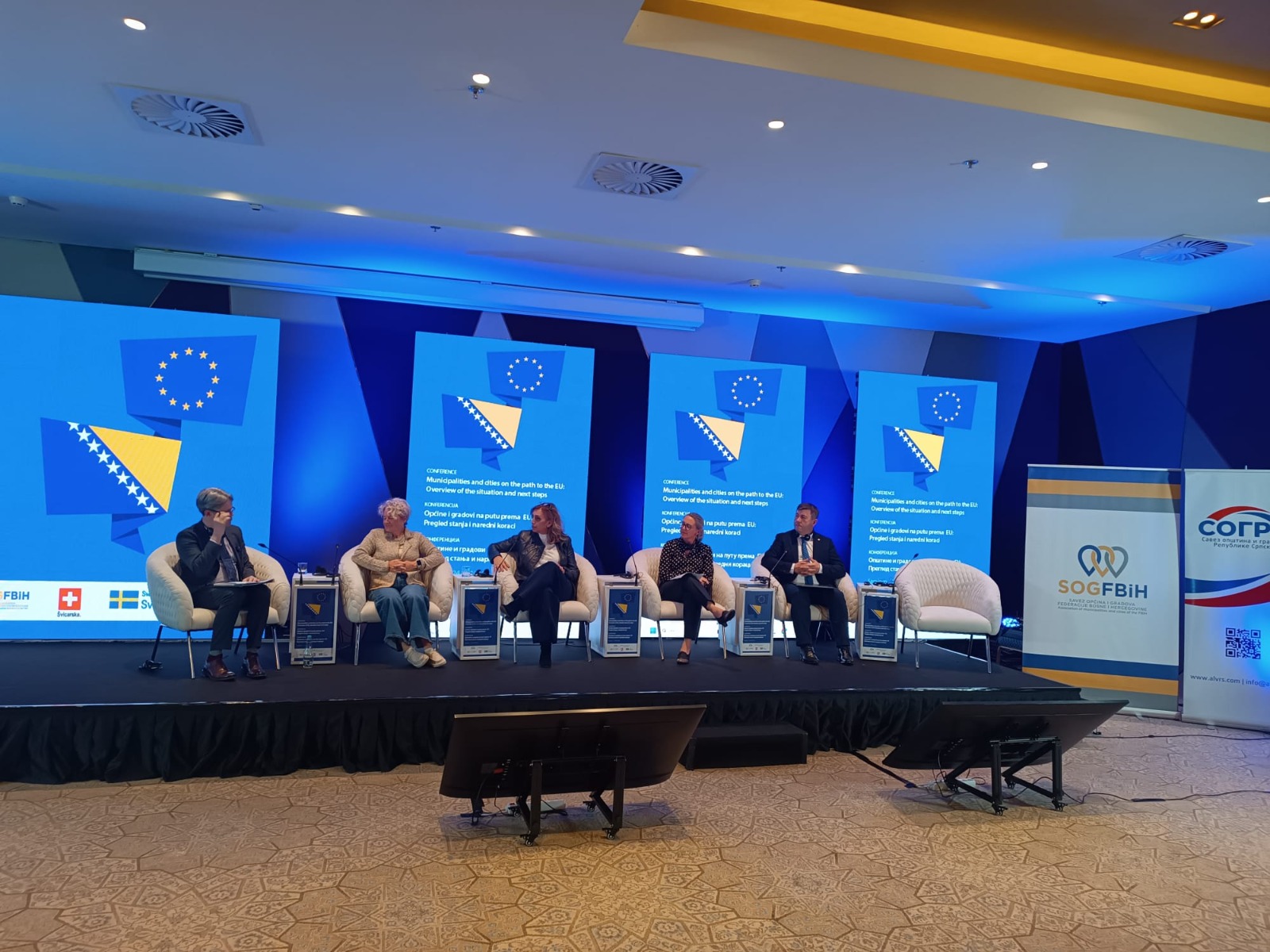
Csaba Borboly, Chair of the European Committee of the Regions Working Group on Bosnia and Herzegovina, participated in the conference “Municipalities and Cities on the Road to EU Accession: Taking Stock, Looking Ahead”, held in Sarajevo on 24 September.
The conference brought together mayors, municipal associations, representatives of the European Union, national and subnational authorities, researchers and international development partners. Its purpose was to examine how municipalities and cities in Bosnia and Herzegovina can prepare for EU accession and contribute effectively to the country’s European path.
Enlargement must not create two Europes
The European Union cannot afford to become a continent divided between regions that shape policies and regions that are expected only to implement them. Enlargement must strengthen European unity, democratic participation and solidarity.
There must not be one Europe that makes the rules and another that merely carries the costs. The principles of partnership, solidarity, subsidiarity and respect for diversity should guide relations with both current and future Member States, while recognising their different legal and institutional status during the accession process.
A credible enlargement policy must therefore involve local and regional authorities from the beginning. They are closest to citizens and are responsible for many of the services through which people experience European policies in their daily lives.
“EU integration is not only about legislation. It is about implementation in villages, towns and regions. Central and competent authorities conduct the negotiations, but much of the implementation takes place at local and subnational level. Both need to be part of the process,” Borboly said during the discussion.
Romania’s lesson: local dialogue must begin earlier
Romania’s EU membership has delivered major economic, social and development opportunities. At the same time, Borboly stressed that Romania’s accession experience also offers an important lesson regarding the involvement of local and regional authorities.
Drawing on that experience, he argued that structured dialogue with local and regional authorities should have started earlier and should have played a stronger role during crucial stages of the accession process.
Many commitments were agreed at central level, while their practical implementation later depended on counties, municipalities, local public utilities and local communities.
This became particularly visible in areas such as water and wastewater infrastructure, waste management, environmental protection, public procurement and access to European funding. Legislation and financing opportunities existed, but local authorities did not always have sufficient time, staff, technical documentation or mature projects to implement the commitments effectively.
Bosnia and Herzegovina now has an opportunity to avoid similar difficulties. Its two Associations of Municipalities and Cities should continue working together, develop common positions and seek formal participation in structures preparing the accession process.
National and other competent authorities should welcome this contribution and ensure that the local voice is heard before responsibilities, deadlines and financing arrangements are finalised.
Local capacity is European capacity
Environmental legislation provides a clear example of why the local dimension matters.
EU standards on water, wastewater, waste, air quality, biodiversity and climate action may be developed and negotiated at European, national and other competent levels, but a large part of their practical implementation takes place in local communities.
Municipalities must operate public services, prepare investments, manage procurement procedures, communicate with citizens and explain the costs and benefits of reform.
Smaller, rural and less-developed municipalities face an especially difficult task because they often have significant infrastructure and investment needs while operating with more limited administrative and technical capacity.
Enlargement policy must therefore connect three elements: local responsibility, local capacity and access to funding.
Assigning new responsibilities without providing the knowledge, staff, technical assistance and financial tools needed to deliver them risks weakening public confidence in both national reforms and European integration.
Recognition for SALAR and Swiss and Swedish support
The work carried out by SALAR International together with the two Associations of Municipalities and Cities in Bosnia and Herzegovina, with Swiss and Swedish support, provides an important example of how enlargement can be prepared in practice.
The conference was organised within the project “Strengthening the Associations of Municipalities and Cities in Bosnia and Herzegovina”.
The project is funded by the Swiss Agency for Development and Cooperation and the Swedish International Development Cooperation Agency, and is implemented by SALAR International together with the two Associations of Municipalities and Cities of Bosnia and Herzegovina.
This cooperation has helped strengthen European integration networks, inform municipalities about EU standards, develop local expertise and improve the representation of common municipal interests.
Reflecting on Romania’s own accession experience, Borboly noted that this kind of systematic and early capacity-building support was not always sufficiently available to local authorities during crucial stages of preparation.
This experience demonstrates why capacity building cannot wait until negotiations are almost complete. Local institutions need time to understand future obligations, prepare investments, train staff and build public support.
SALAR International and its Swiss, Swedish and local partners deserve recognition for treating municipalities not simply as beneficiaries, but as democratic partners in the European integration process.
European values must be implemented locally
The European Union is based on democracy, subsidiarity, solidarity, partnership and respect for diversity. These principles should also guide enlargement.
Subsidiarity means that decisions should be taken as closely as possible to citizens. Partnership means listening to the institutions that will ultimately implement those decisions. Solidarity means that weaker regions and smaller municipalities should not be left alone with the most difficult and costly parts of implementation.
A stronger local role does not have to weaken national authorities or slow down accession. On the contrary, early involvement of municipalities and regions can identify practical difficulties before agreements are finalised.
It can make commitments more realistic, investments better prepared and implementation more effective.
Europe’s unity will not be protected by asking every region to become identical. It will be strengthened by ensuring that all regions have meaningful opportunities to participate, contribute and benefit.
The Working Group’s next steps
The European Committee of the Regions Working Group on Bosnia and Herzegovina provides a platform for political dialogue between local and regional representatives from the European Union and Bosnia and Herzegovina.
It supports the exchange of experience and helps keep the local and regional dimension of enlargement on the European agenda.
The Working Group’s next meeting will take place in Travnik on 5 November.
Discussions will focus on access to funding for local and regional authorities and their role in implementing and monitoring the Reform Agenda.
Particular attention will be given to the practical needs of municipalities, including project preparation, administrative capacity, technical assistance and access to available resources.
The longer-term objective should be an even stronger and more stable institutional partnership between the European Committee of the Regions and the local and regional authorities of Bosnia and Herzegovina.
One Europe, built from the ground up
Enlargement is not only about extending the European Union’s borders. It is also about extending democratic participation, European standards and real opportunities to more communities.
The future of Europe cannot be decided only in capitals. It must also be shaped by mayors, local and regional representatives, municipal experts and the citizens who experience European policies through the quality, accessibility and cost of local services.
The message from Sarajevo is clear: Europe must not develop in a way that leaves some regions with influence and others primarily with obligations.
Member States, candidate countries and local and regional authorities need to work together, uphold shared European principles and prepare implementation well before accession.
One Europe requires one standard of respect: every community affected by a decision should have a meaningful opportunity to help shape it.