The European Commission is currently collecting experiences and proposals on housing supply and affordability. The consultation is open until 30 September 2026, and its results will help shape the Housing Simplification Package, which is expected to be prepared by 2027.
For Borboly Csaba, member of the European Committee of the Regions, this is not simply another public consultation. It is an opportunity for local and regional communities to influence rules that will determine how housing, renovation and construction policies work across Europe in the coming years.
European housing policy must reflect territorial differences
Housing challenges are very different from one region to another.
Large cities face rapidly increasing property prices and rental costs, while rural and mountainous areas often struggle with ageing housing stock, depopulation, limited infrastructure, shortages of technical professionals and administrative capacity, and difficulties in accessing investment.
According to Borboly Csaba, European legislation cannot be designed exclusively around the realities of capitals and major urban centres.
The same rules can have very different effects in a large city and in a small rural municipality. For this reason, he has repeatedly advocated a place-based, bottom-up approach within the European Committee of the Regions.
The objective is not to weaken safety, environmental, seismic or heritage protection standards. The objective is to make procedures clearer, proportionate and more predictable, while taking into account the different capacities of Europe’s regions and municipalities.
Housing is also about keeping young people in their communities
Affordable housing is closely connected to demographic and regional development.
For many young Europeans, the question is not only whether they can purchase or rent a home, but whether they can build a future in the region where they grew up.
In rural and less-developed areas, housing difficulties are often combined with limited employment opportunities, infrastructure gaps and complicated renovation or construction procedures.
This is why Borboly Csaba considers housing policy to be much more than a construction issue. It is also a question of youth retention, regional competitiveness, social cohesion and territorial equality.
According to European Commission estimates, approximately EUR 153 billion in investment per year would be needed to enable the construction of around two million new homes annually in Europe.
How these resources and future programmes are designed will therefore be crucial for less-developed regions.
Bringing regional experience into European decision-making
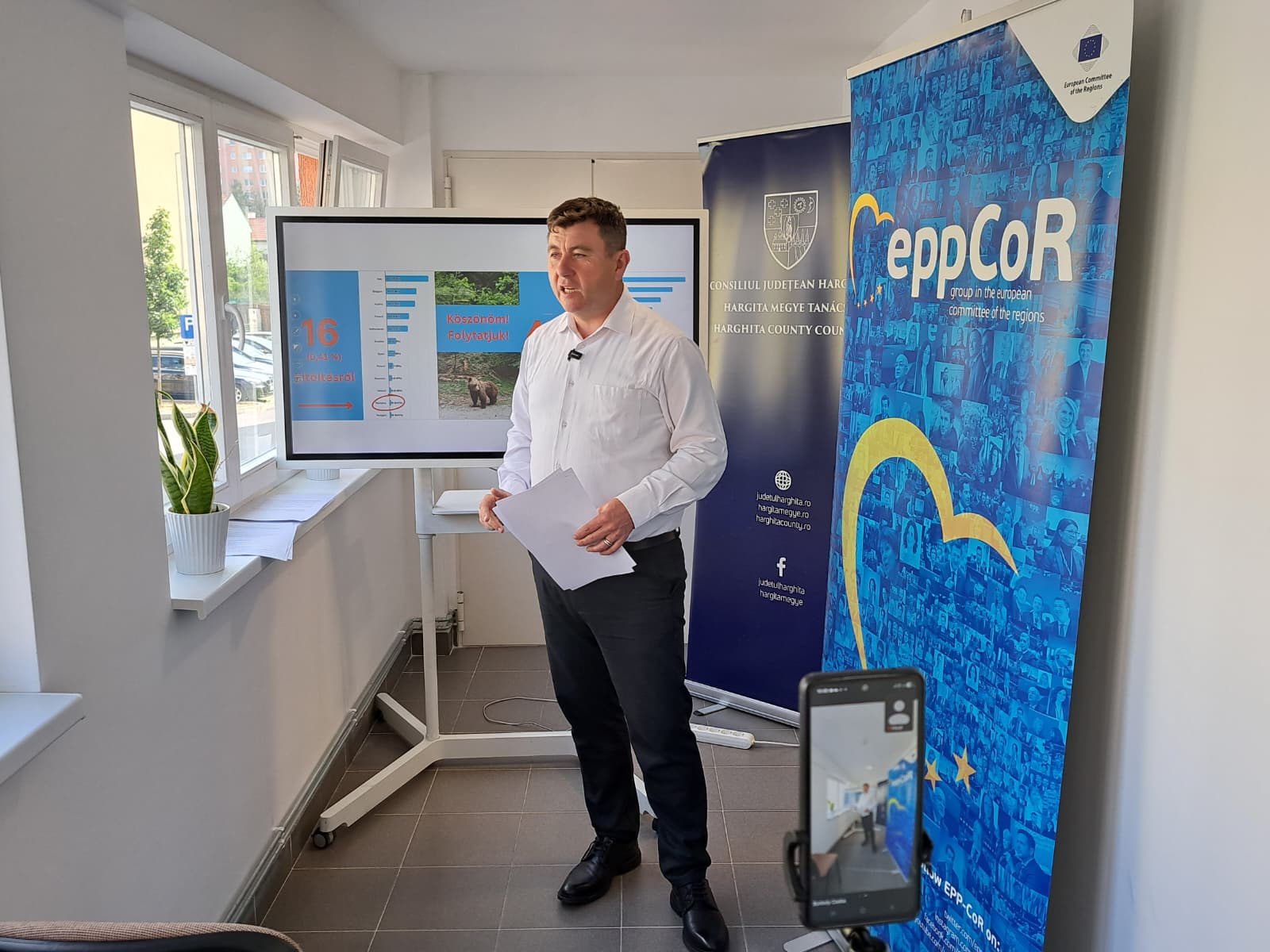
Borboly Csaba has raised housing-related issues within the European Committee of the Regions and has called for future housing action plans to be based on local realities rather than solely on centrally designed solutions.
During the Committee of the Regions’ plenary debate on 2 July, he stressed the importance of place-based and bottom-up planning.
His position is that local and regional authorities should not become merely implementers of decisions taken at national or European level. They should participate in shaping those decisions from the beginning.
This is particularly important now, as preparations are underway for the 2028–2034 EU budget, while national housing strategies and future European financing instruments are also being developed.
Harghita County as a practical example
Harghita County illustrates many of the challenges faced by mountainous and predominantly rural regions across Europe.
Questions of affordable housing, renovation of older homes, energy efficiency, access to infrastructure, traditional architecture and the availability of skilled professionals are closely interconnected.
For this reason, Borboly Csaba previously proposed the preparation of the Harghita County Affordable Housing Strategy 2035, the establishment of an Affordable Housing Working Group and, later, the preparation of a county Housing Action Plan.
These local initiatives are intended not as isolated county projects, but as practical examples of how regional experience can feed into national and European policymaking.
The same approach has guided initiatives connecting the local wood industry, modern construction technologies and community preservation, including the “Let’s Build with Wood!” programme and the Modern Szekler House 2.0 concept.
Less-developed and mountainous regions need a stronger voice
Borboly Csaba has also submitted concrete proposals to Romania’s Ministry of Development, Public Works and Administration.
Among them are the introduction of a specific focus on mountainous and rural areas in national housing policy, the collection of more detailed territorial housing data and stronger regional involvement in preparations related to future European programmes, including the New European Bauhaus Facility.
The broader objective is clear: less-developed regions should not only receive funding after programmes have already been designed. They should also participate in defining priorities and rules.
For Borboly Csaba, this is one of the central principles of his work in the European Committee of the Regions.
The European consultation is an opportunity to provide real evidence
The European Commission is now asking citizens, local authorities, professionals, companies and organisations to share their experiences.
The purpose is not to submit identical or standardised responses.
The most useful contributions are those that describe real situations:
- What housing, construction or renovation problem occurred?
- Which regulation, administrative procedure or lack of capacity created difficulties?
- How much additional time or cost did it generate?
- What simpler and safer solution could address the problem?
Experiences from small municipalities, mountainous communities and less-developed regions are particularly valuable because these realities can otherwise be underrepresented in European-level consultations.
The deadline is 30 September 2026
Borboly Csaba encourages colleagues in the European Committee of the Regions, local and regional authorities, professional organisations, businesses and citizens across Europe to participate and to encourage their own communities to do the same.
Official consultation:
Housing supply and affordability – regulatory simplification
The consultation remains open until 30 September 2026.
The more diverse territorial experiences reach the European Commission, the greater the chance that future housing rules will work not only in Europe’s largest cities, but also in its villages, small towns, mountainous regions and less-developed communities.
For Borboly Csaba, this is the essential message: European housing policy must be shaped together with the regions and communities that will ultimately have to put it into practice.