From Brussels to Miercurea Ciuc: Mountain Waters May Reach the European Agenda
23 March 2026 | Brussels, Charlemagne Building
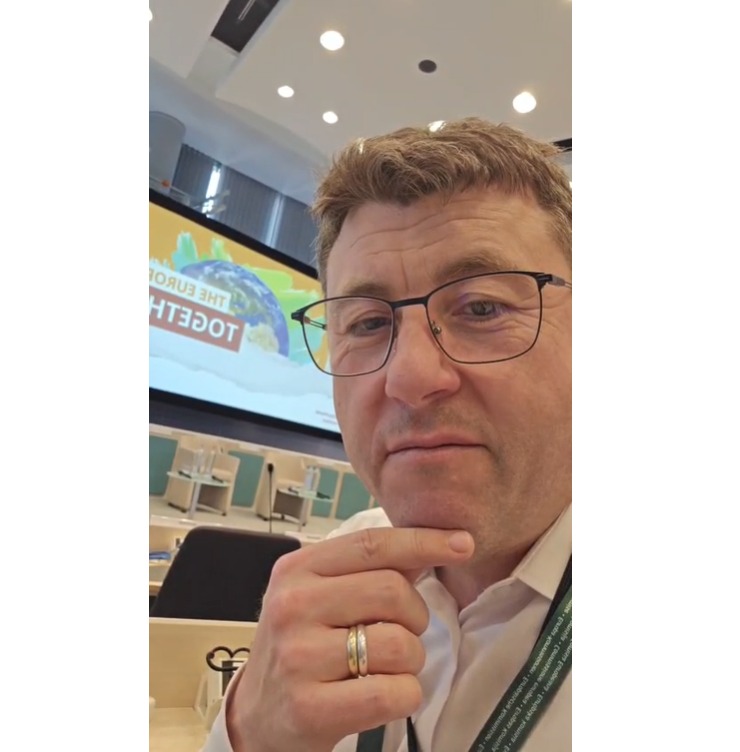
Today in Brussels, at the headquarters of the European Commission, the annual flagship event of the European Climate Pact — Together in Action — is taking place. Over three days, policymakers, mayors, activists, scientists, and young people are discussing how climate action can be implemented in practice.
Csaba Borboly, member of the European Committee of the Regions and Vice President of the Harghita County Council, is participating in the event and will speak in a panel discussion addressed to mayors and local communities.
This is not a routine participation. There is something to say — and something to build on.
What We Have Achieved So Far — and Why It Matters Today
In November 2025, we organized the Mountain Water Resilience Conference in Miercurea Ciuc, with the participation of Kata Tüttő, President of the European Committee of the Regions. Mayors, farmers, forest owners, researchers, and young people sat at the same table — not because Brussels asked them to, but because the issue belongs to them. Our springs, streams, and ecosystems are at stake.
From that conference, a concrete document emerged: the Carpathian Water Resilience Framework Proposal, coordinated by Harghita County Council and the REPER21 Association, within the European Climate Pact’s Shaping Tomorrow initiative.
This document proposes:
- local water governance committees,
- micro-regional pilot areas,
- community-based monitoring networks,
- nature-based solutions,
and promotes the idea that mountain water issues are not merely local concerns, but matters of European security.
On 4 March 2026, the European Committee of the Regions unanimously adopted its opinion on the European Water Resilience Strategy. Our proposals are included in that document: local committees, community participation, special attention to mountain regions, and dedicated funding in the next Multiannual Financial Framework.
The work has been done. The question now is what the European Commission, the European Parliament, and the Council of the EU will do with these proposals.
What Was Represented Today in Brussels
The topic of today’s panel discussion is how mayors, local councils, and citizens co-design a fair and sustainable future.
The key message is clear: co-design is only real if those who live closest to the resources are at the table. A mayor from a small mountain municipality, a farmer, a young person — they are the ones who understand what is changing in streams, forests, and pastures.
If they are left out, we are not co-designing — we are merely consulting.
A concrete proposal was also presented: the Carpathian Water Resilience Framework Proposal is an open document, ready for collaboration and partnership — with the Covenant of Mayors, DG CLIMA representatives, and the Climate Pact community alike.
In the Water Resilience Stakeholder Platform launching in 2026, mountain micro-regions must have a place.
The Role of Harghita County Council — Taking Responsibility
None of this would have been possible without the active involvement of the Harghita County Council.
The council coordinated the conference in Miercurea Ciuc, issued the Carpathian Water Resilience Framework Proposal under its name, and submitted amendments within the Committee of the Regions.
But this is only the beginning.
The next step is for the council to take this work further at the micro-regional level: supporting mayors, farmers, and landowners in developing their own water resilience plans, and connecting these to European funding and regulatory frameworks.
It is not enough to think at county level. This work must reach the Ciuc Basin — every small watershed.
Continuing the Work of Barna Tánczos
It is also important to acknowledge the work carried out by Barna Tánczos as Minister of Environment in Romania.
Programs launched during his mandate — including the genetic assessment of the bear population, electric fencing schemes, and environmental data collection — represent work of European-level rigor. They provide a strong foundation for credibly representing mountain environmental protection and water management today.
This work must continue:
- new EU funding must be accessed,
- new concepts must be developed,
- and Romania must remain part of the European processes shaping water, nature, and climate policy.
The Three Pillars: CoR, Romanian Government, European Parliament
Mountain water issues can only reach and remain on the European agenda if supported simultaneously from three sides:
- The European Committee of the Regions — the groundwork has been done, and the proposals are included in the adopted opinion
- The Romanian Government — must join the Water Resilience Alliance and integrate mountain-specific aspects into national climate and energy plans
- The European Parliament — must ensure that mountain regions receive dedicated attention in the water strategy and in negotiations on the next Multiannual Financial Framework
If these three pillars stand together, mountain water protection will no longer be just a local effort — but a shared European cause.
Together, Bottom-Up
The meaning of being present in Brussels is precisely this: what we build at home — conferences, documents, local partnerships — gains a European voice and feedback here.
There is no contradiction between the table in Miercurea Ciuc and the one in Brussels. It is the same work, continued at a different level.
This is the essence of the local approach.
We are not waiting for solutions to come from above. We bring our knowledge upward — and bring back connections, feedback, and opportunities that can become reality at home.
Thanks to all partners in this work: the staff of Harghita County Council, the REPER21 team, the research institute in Miercurea Ciuc, the conference participants, and especially the mayors, farmers, and young people whose knowledge and experience form the foundation of this entire effort.