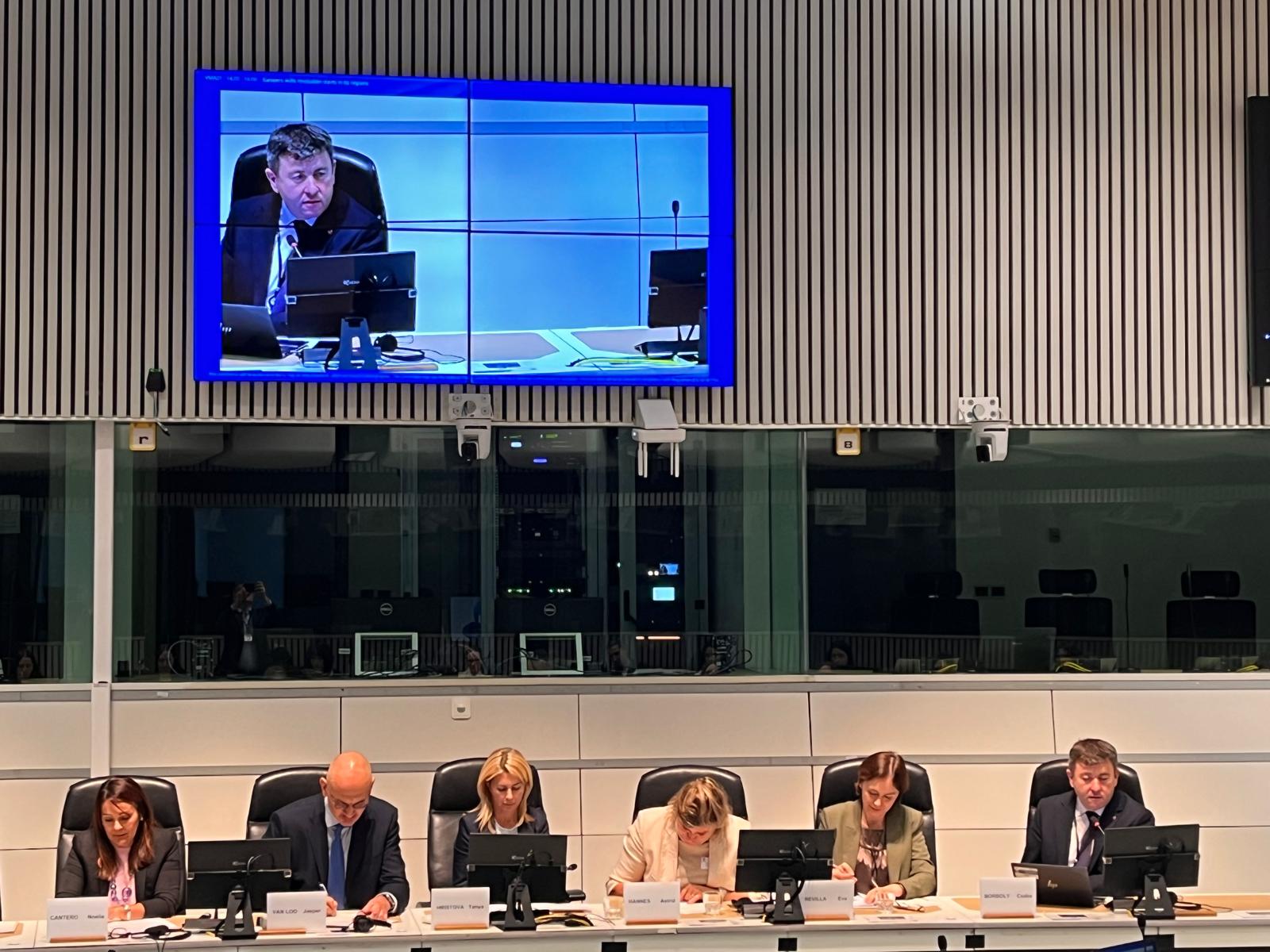
At today’s joint event of the European Committee of the Regions and Cedefop, I argued for a simple principle: local and regional authorities must help shape European skills policy from the beginning, not merely implement decisions made elsewhere. Europe needs common goals, but each territory needs solutions that fit its people, economy and capacity.
Why representation in Brussels matters
A sentence negotiated in Brussels today may become a funding condition, performance indicator or eligibility rule tomorrow. If rural, mountain, border and remote regions enter the discussion only after a programme has been designed, they are already late. Their realities must be present when European tools and future funding pathways are built.
The launch of Cedefop’s Regional Skills Ecosystems Index, RESET, creates an important opportunity. The tool makes 244 European regional skills ecosystems comparable and can show where a region is strong or where action is needed. But data is valuable only when it changes decisions. Otherwise, it remains a map.
One Europe has many skills realities
NUTS 2 data is useful for European comparison, but a regional average can hide deep internal differences. A successful capital or university city may improve the overall result while rural and mountain communities continue to lose young people, small firms cannot find workers and access to training remains limited.
I therefore proposed connecting RESET with NUTS 3 and local information where reliable data is available. In Romania, NUTS 3 corresponds to the county level, where many practical decisions are taken. NUTS 2 shows the region. NUTS 3 shows where people actually face the problem.
This is not a call to abandon a common European framework. It is a call to test its next practical layer. I proposed a joint pilot between Cedefop and the Committee of the Regions, involving different territorial realities, including rural, mountain, border, remote and industrial transition areas. Eastern regions should help design this work rather than receive a finished model at the end.
No second Europe of limited capacity
Europe must not divide into two realities. In one, regions have strong universities, research centres, professional networks and the staff required to use every opportunity. In the other, communities are formally eligible for the same programmes but lack the capacity to prepare projects, organise training or test new technology.
Equal access on paper does not automatically create equal opportunity. Regions with weaker skills and innovation ecosystems need technical assistance, trained staff, institutional capacity and targeted investment. A weak RESET result must not become a label or a reason to withdraw support. It should trigger help and a credible pathway towards improvement.
This is also a question of European values. Solidarity means enabling every territory to act. Cohesion means reducing the distance between opportunity and the citizen. Subsidiarity means involving the level of government closest to the problem. Democracy means that communities can recognise their reality in the decisions that shape their future.
Permanent partnerships turn data into action
The main actors too often work separately. Employers understand emerging skills needs. Schools and training providers know how learning can be organised. Universities contribute research and innovation. Employment services and social partners know the labour market. Local and regional authorities understand their communities and can bring these actors together.
Every region should have a permanent skills and innovation partnership. This should not become another administrative layer. It should be a working platform with shared evidence, agreed priorities, named responsibilities, timelines and measurable action plans. Trust and institutional capacity require continuity. Short projects alone cannot build them.
Small and medium sized enterprises deserve particular attention. A large employer can hire experts, organise training and invest in demonstration facilities. Small firms often cannot do this alone, even though they provide many local jobs. Regional cooperation can pool training, expertise, mentoring and technological infrastructure so that digital and AI adoption does not create a new productivity gap.
Skills policy is jobs policy
Skills policy is not only about education. It is about wages, competitiveness, public services and regional development. Training should help people before their jobs disappear, not only afterwards. Regional skills intelligence can become an early warning system by combining labour market information with technological change, investment and demographic trends.
Artificial intelligence also requires a human centred approach. Not everyone must become an AI specialist. But workers, teachers, entrepreneurs and civil servants need enough knowledge and judgement to understand opportunities and limits, assess outputs, recognise bias, protect data and know when human responsibility must prevail.
Talent mobility is a European strength, but sustained one way flows can weaken regions that have invested in educating their young people. Europe should also support talent circulation, return, remote collaboration and stronger links between diasporas and regional innovation ecosystems. Good skills should lead to good jobs, and good jobs should give people a reason to stay or return.
Funding should follow territorial plans
Future European funding will have greater impact when it connects skills, productive investment, innovation capacity and economic diversification. Regions therefore need to prepare now. A territory with a shared vision, reliable evidence, committed partners and mature projects can move quickly when an opportunity opens. A territory without these foundations may remain outside the corridor through which funding and cooperation flow.
This is why place based policymaking matters. It does not weaken European coordination. It makes European ambition deliverable. The Union can define common goals, share data and finance long term capacity. Regions and cities can translate these goals into training, investment and quality jobs that reflect local realities.
East and west must shape the future together
Eastern regions bring valuable experience in rural resilience, demographic change, small business economies and community cooperation. Western regions bring mature support systems, specialised infrastructure and tested models. Europe becomes stronger when these capacities connect through joint curricula, shared experts, interregional innovation facilities and long term partnerships.
We should not create one Europe that designs the transition and another that manages its consequences. The next decade must be shaped together. That requires listening before rules are fixed, opening European instruments to territorial evidence and ensuring that weaker regions receive the capacity to participate.
From an open door to prepared action
My role in Brussels is to open doors, bring local evidence into European debates, propose practical changes and build partnerships. The next step must happen in our regions. Information has to be processed. Partners have to meet. Responsibilities have to be assigned. Projects have to be prepared before the funding call appears.
The question is what we leave to the next generation: trust and cooperation, or indifference and distance. Europe’s democratic strength will be measured not only by the decisions it adopts, but by whether people in every region can use those decisions to build a dignified future. RESET should not only describe regional differences. It should help regions change their future.