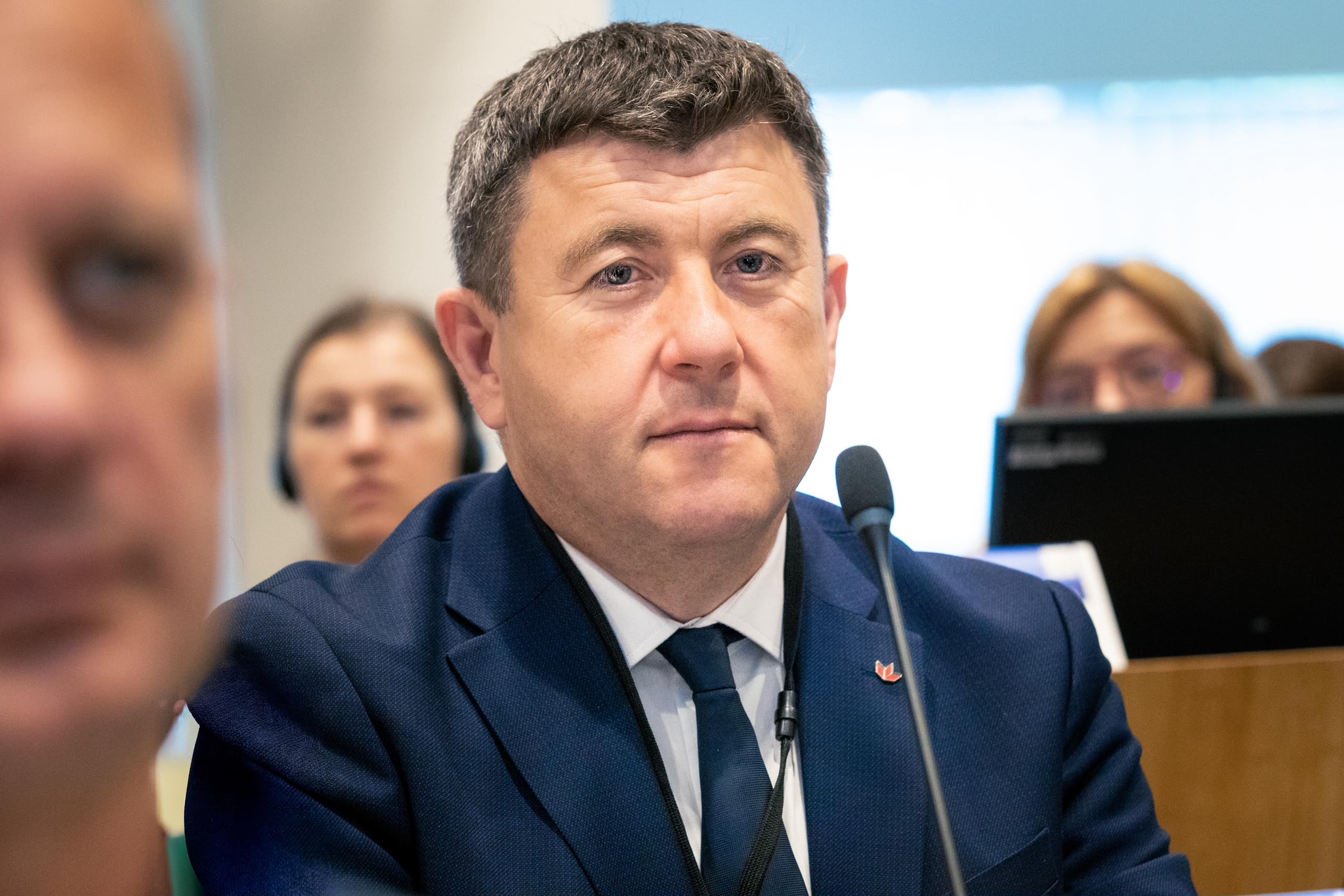
Brussels, 3 June 2026 — Borboly Csaba, Member of the European Committee of the Regions (CoR) and Chair of the Working Group on Bosnia and Herzegovina, today participated and took the floor at the closing plenary session of the 11th CoR Enlargement Days, held at the Jacques Delors building in Brussels. This session was the culmination of the entire two-day event: the CoR President, the European Commissioner for Enlargement, high-level representatives of the European Parliament, the rotating Council Presidency, and all chairs of JCCs and Working Groups gathered around a single question — how does EU enlargement become reality, and who delivers it on the ground.
The answer was unanimous: local and regional authorities.
Why was this session significant?
The CoR Enlargement Days are not a routine briefing event. This is the platform where local and regional representatives from EU member states meet with local and regional leaders from candidate countries — and where together they shape the political message that subsequently reaches the European Commission, the European Parliament, and national governments.
Borboly Csaba was present at the event for both days. On 2 June he chaired the third session of the Working Group on Bosnia and Herzegovina, attended by elected local officials from both the Federation and Republika Srpska, EEAS FIMI experts, the OSCE, and Bosnian civil society researchers. On 3 June he took the floor at the Plenary — bringing directly before the EU’s highest enlargement forum the experiences and proposals born on the ground, at the level of local authorities.
Three messages Borboly Csaba brought to the Plenary
- Local authorities are not passive implementers — they are political actors who must be involved in the design of reforms.
70% of the EU acquis is implemented at local and regional level. Yet reform plans — in the case of BiH, the Reform Agenda — are largely negotiated at national level, without the involvement of local authorities. Mayors from both entities — the Federation and Republika Srpska — said the same thing: political will exists at local level even when it is absent nationally. That will is a resource that the EU must recognise and channel through concrete institutional mechanisms. - Resources from the Growth and Reform Facility must reach local authorities.
400 million euros are available for Bosnia and Herzegovina under the Growth and Reform Facility. These funds are blocked — not because reforms were not delivered, but because the country has not appointed a coordinator and has not ratified the necessary agreements. While the political blockade persists, local authorities continue their work: infrastructure, water management, digitalisation, social services. Borboly Csaba was unambiguous: the funds must be unblocked and directed directly to the level of municipalities and regions. - The fight against disinformation must start locally — but within a democratic framework.
The EU enlargement process is actively undermined by disinformation campaigns. Anti-EU narratives — claiming that the EU weakened itself through sanctions against Russia, or that the EU censors free speech — reach 61–62% of Bosnian citizens according to recent surveys. Borboly Csaba stressed: resilience against disinformation is strongest where local authorities, journalists and civil society work together. He also warned: anti-disinformation measures must not become a pretext for restricting freedom of expression or media pluralism.
A united Central European voice — and what it means
At the Plenary, Borboly Csaba was not alone in representing the CoR enlargement working bodies. All chairs of Working Groups and Joint Consultative Committees were present — for Ukraine, Moldova, Georgia, the Western Balkans, and Turkey. This presence is not symbolic. These chairs are in daily contact with local and regional authorities in candidate countries, and are able to exercise unified political pressure on EU institutions.
When these countries join the EU, the balance of power shifts. Local and regional representatives of new member states will also hold voting rights in the CoR. The regions joining us — mountainous, border, minority community areas — will become natural allies of existing member state regions facing similar challenges. What today requires hard-won exceptions may tomorrow become the rule: the logic of place-based development, which prioritises bottom-up resource allocation, rewards exactly those regions that begin planning early, build partnerships, and present real projects.
The Global Europe programme — the next step
The plenary and Working Group discussions gave significant attention to the 2028–2034 MFF and the Global Europe programme, under which cross-border cooperation projects can be financed — not only for candidate countries, but also for regional authorities in EU member states working with partners in candidate countries.
This creates a direct opportunity for Harghita County Council. The constraints are not technical — the programmes exist, the money is available. The condition: advance project plans, signed partnership agreements, and application capacity. Discussions must begin now with the Berehove area (Transcarpathia, Ukraine), the Strășeni district (Moldova), and partner municipalities in Bosnia.
The gates are open. The question is whether we step through them — and that work must start now.
2028 — not an ending, but a beginning
The EU’s next decade will be defined by place-based development. This means: it is not Budapest or Bucharest that first decides how many resources go to a mountain micro-region — resources are allocated based on local plans, local partnerships, and demonstrated local capacity. This is a structurally favourable shift for regions that are not located in the capital, but have a plan, have partners, and have political representation.
RMDS/UDMR participation in national governance further strengthens this opportunity. National political access combined with local development ambition is a rarely available window. That window must be used now: projects planned, working consortia built, and a message sent to Brussels — Harghita County is here, is ready, and is moving.
The choice is not to wait and see. The choice is to decide now what the next ten years will look like.