Local realities must be heard in Brussels
The Carpathian regions face challenges that cannot be solved from a distance. Mountain communities live every day with the consequences of large carnivore conflict, water-related climate risks, underfunded rural infrastructure and policies that are too often designed without sufficient attention to local realities.
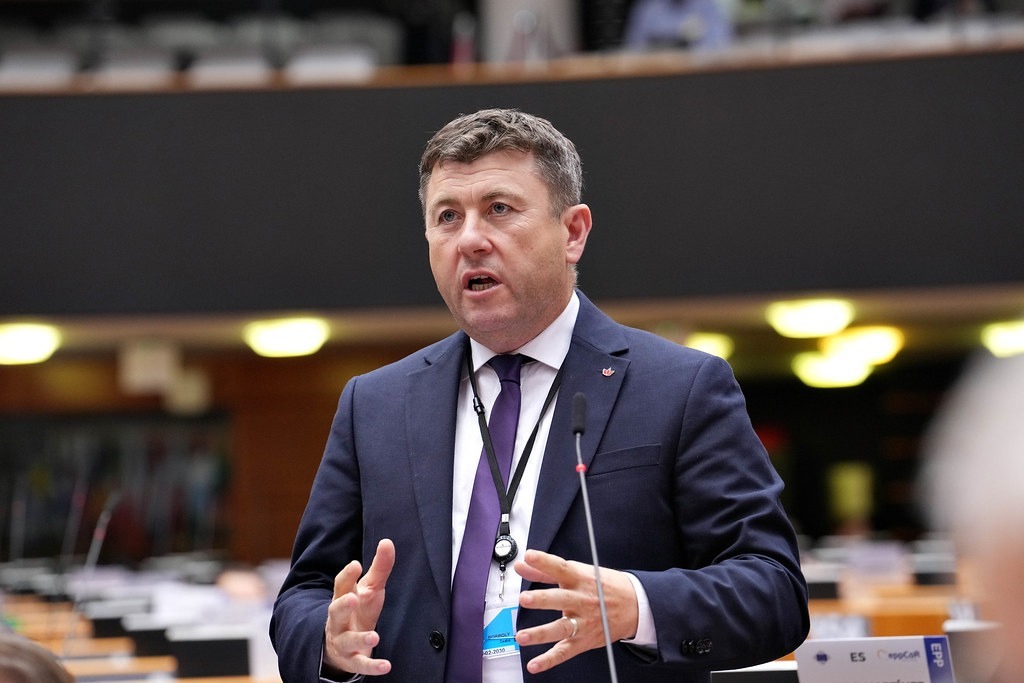
On 2 July 2026, in Brussels, Csaba Borboly, Vice-President of Harghita County Council, addressed the Carpathians Interregional Group of the European Committee of the Regions. Speaking as rapporteur for the CoR opinion on biodiversity conservation and coexistence with large carnivores, he presented concrete proposals on two key issues: large carnivore management and mountain water resilience.
Both sets of proposals received a positive response. The representative of DG REGIO also confirmed that the ideas presented are actionable at Brussels decision-making level.
This work did not begin today, and it will not end today. It is a sustained, week-by-week and month-by-month process — and it continues until the goals are reached.
What is the Carpathians Interregional Group?
The European Committee of the Regions is the EU institution where locally and regionally elected representatives — not national governments — have a direct institutional voice in shaping European legislation and policy.
The Carpathians Interregional Group brings together regions connected by the Carpathian mountain range, including territories from Romania, Poland, Slovakia, Ukraine and Serbia.
This is not a ceremonial gathering. It is an institutional space where the daily realities of mountain farmers, shepherds, flood-threatened villages and communities living alongside large carnivores can be translated into concrete European policy input.
Large carnivore management: facts, proposals and a common Carpathian position
What the data shows
Csaba Borboly’s intervention was based on specific and verifiable data from Harghita County.
In 2025, Harghita County recorded:
- 25 ambulance interventions related to bear attacks, with 4 persons transported to hospital;
- 305 agricultural damage cases filed with the county agricultural directorate;
- 232 gendarmerie cases linked to bear presence or attacks, of which 203 occurred inside settlements;
- 155 RO-Alert emergency notifications issued because of bears;
- 9 road accidents involving bears, recorded by police.
These are not isolated incidents. They represent the daily reality of life in a Carpathian mountain county.
Romania’s national genetic monitoring, published in 2025, estimates the brown bear population at between 10,000 and 12,800 individuals — approximately three times the assessed ecological carrying capacity of the territory.
The data exists. The problem is acknowledged. What is still missing is a coherent, regionally differentiated EU-level response.
The same challenge across the Carpathians
This situation is not unique to Romania. Across the Carpathian range — in Poland, Slovakia and beyond — mountain communities are facing the same structural tension.
Conservation frameworks are designed at European level, while the costs are borne almost entirely by local communities. Recognition remains limited, and compensation is often insufficient.
The message from the Carpathian regions is clear: conservation must remain credible, but it must also be fair, realistic and adapted to the territories that carry its consequences every day.
Five concrete proposals on large carnivores
At the Brussels session, Csaba Borboly presented five concrete proposals, which received a positive response from the Intergroup.
1. A common Carpathian position on large carnivore management
The first proposal calls for a shared Carpathian position, with human life and safety as the explicit first priority.
This position would be submitted to the CoR ENVE and NAT commissions as formal Carpathian input to the ongoing opinion process.
2. A science-based review of the brown bear’s protection status
The second proposal calls for a science-based, regionally differentiated review of the brown bear’s protection status under the Habitats Directive.
This would apply specifically to territories where population data and conflict data jointly justify such a review.
This is not a call to abandon conservation. It is a call to make conservation credible in territories that bear its full cost.
3. A joint Carpathian input to EU nature and restoration processes
The third proposal focuses on a joint Carpathian contribution to the Habitats Directive stress test and the implementation of the Nature Restoration Law.
This input would specifically address human–large carnivore conflict in mountain regions. National restoration plans should include a dedicated action chapter on this issue.
4. A shared Carpathian large carnivore data package
The fourth proposal is to build a shared data package combining figures from ambulance services, emergency systems, agricultural authorities, gendarmerie and police across Carpathian regions.
Cross-border data infrastructure for large carnivore conflict management is exactly the kind of joint regional investment that Interreg can and should support.
5. A dedicated EU financing mechanism for conflict management
The fifth proposal calls for a dedicated EU financing mechanism for large carnivore conflict management in the 2028–2034 Multiannual Financial Framework.
The current LIFE and CAP instruments are not fit for purpose in overpopulation zones. In areas with high bear density, mountain farmers are no longer working eight-hour days. They are working twenty-four-hour days.
That is a documented and verifiable reality that must be reflected in the future EU funding architecture.
A renewed institutional path
The consultation with the CoR secretariat confirmed that the process is on track to identify the appropriate institutional form for the Committee of the Regions to again address the European Commission.
The objective is to request a review of the bear’s protection status in member states where human fatalities have occurred.
Mountain water resilience: Europe’s water tower deserves European investment
The challenge that lowland policy misses
The Carpathians are Europe’s water tower. The rivers that cross the borders of Carpathian countries begin in these mountains.
Climate change in mountain areas does not simply mean less water. It means water arriving at the wrong time, in the wrong place and in the wrong quantity.
One week, flash floods destroy roads, bridges and farmland. The next, drought dries up springs and leaves farmers without a harvest.
Existing EU funding frameworks have overwhelmingly focused on lowland water challenges, leaving mountain communities structurally disadvantaged.
Mountain regions are not only water sources. They are living spaces, cultural landscapes, ecological assets and engines of rural economies. They deserve policy frameworks built for their specific realities — not lowland models adapted after the fact.
What has already been achieved
In November 2025, Harghita County Council organised a conference on mountain water resilience under the European Climate Pact.
This was not a simple consultation. It was a working session where mayors, farmers, foresters, scientists and young people sat at the same table.
From that process, a policy document was produced: the Water Resilience Framework for the Carpathians, coordinated by Harghita County Council.
The framework proposes:
- local water oversight committees;
- community monitoring networks;
- micro-regional pilot areas;
- nature-based solutions;
- stronger cooperation between public authorities, experts and local communities.
The framework treats water not only as a technical issue, but as a social, economic and strategic one.
Earlier in 2026, the Committee of the Regions adopted its Water Resilience Strategy opinion, and the proposals developed in Harghita are reflected in that text.
This is not a coincidence. It is the result of years of deliberate, sustained engagement — one step at a time, without stopping until the work is done.
Three proposals presented in Brussels
At the Brussels session, three concrete steps were proposed on mountain water resilience.
1. A thematic CoR debate on Carpathian water resilience
The Intergroup should formally request a thematic debate at CoR level on Carpathian water resilience.
This debate should lead to a clear common position before the next Multiannual Financial Framework negotiations.
2. A CoR own-initiative opinion on mountain water resilience
A follow-up should be initiated through the NAT commission, with the goal of preparing a CoR own-initiative opinion on mountain water resilience for the 2027 work programme.
This opinion should explicitly address mountain-specific funding instruments, rather than adapting lowland models to mountain realities.
3. A shared Carpathian evidence base
Each member region should contribute a short, comparable territorial snapshot, including:
- flash flood risks;
- drought zones;
- degraded wetlands;
- good local practices.
This shared evidence base is what makes the Carpathian voice credible when speaking before the European Commission and the European Parliament.
Water resilience and Interreg belong together
Water resilience and Interreg are not separate topics.
Transboundary river basins, shared monitoring systems and joint nature-based solutions are exactly the kind of cross-border investments that Interreg should fund.
The two conversations reinforce each other: stronger territorial cooperation can support both climate adaptation and the long-term resilience of mountain communities.
What today means for Carpathian regions across Europe
The Brussels session was not a conclusion. It was one more step on a long road.
The proposals presented and positively received now need to become structured working processes with concrete deliverables.
Several important institutional moments are converging:
- the CoR secretariat confirmed that the path is open for a new own-initiative approach to the European Commission on bear protection status, targeting member states with documented human fatalities;
- the extension of the Interreg Romania–Slovakia–Ukraine–Hungary programme to include the remaining Carpathian countries was on the agenda, directly linking to financing opportunities for both thematic areas;
- preparation for the 2028–2034 Multiannual Financial Framework is intensifying in the second half of 2026.
The European Commission is approaching this cycle with an emphasis on place-based decision-making, territorial partnership plans and local evidence as the foundation for funding frameworks.
This means that regions with prepared positions, solid data and cross-border coalitions have a genuine opportunity to shape outcomes — not just respond to them.
The work continues
For all Carpathian regions facing similar challenges — large carnivore conflict, mountain water stress and structural underfunding — the message from Brussels is clear.
The institutional tools exist. The political window is open. The evidence base is stronger than ever.
The work continues, step by step, until the goals are reached.