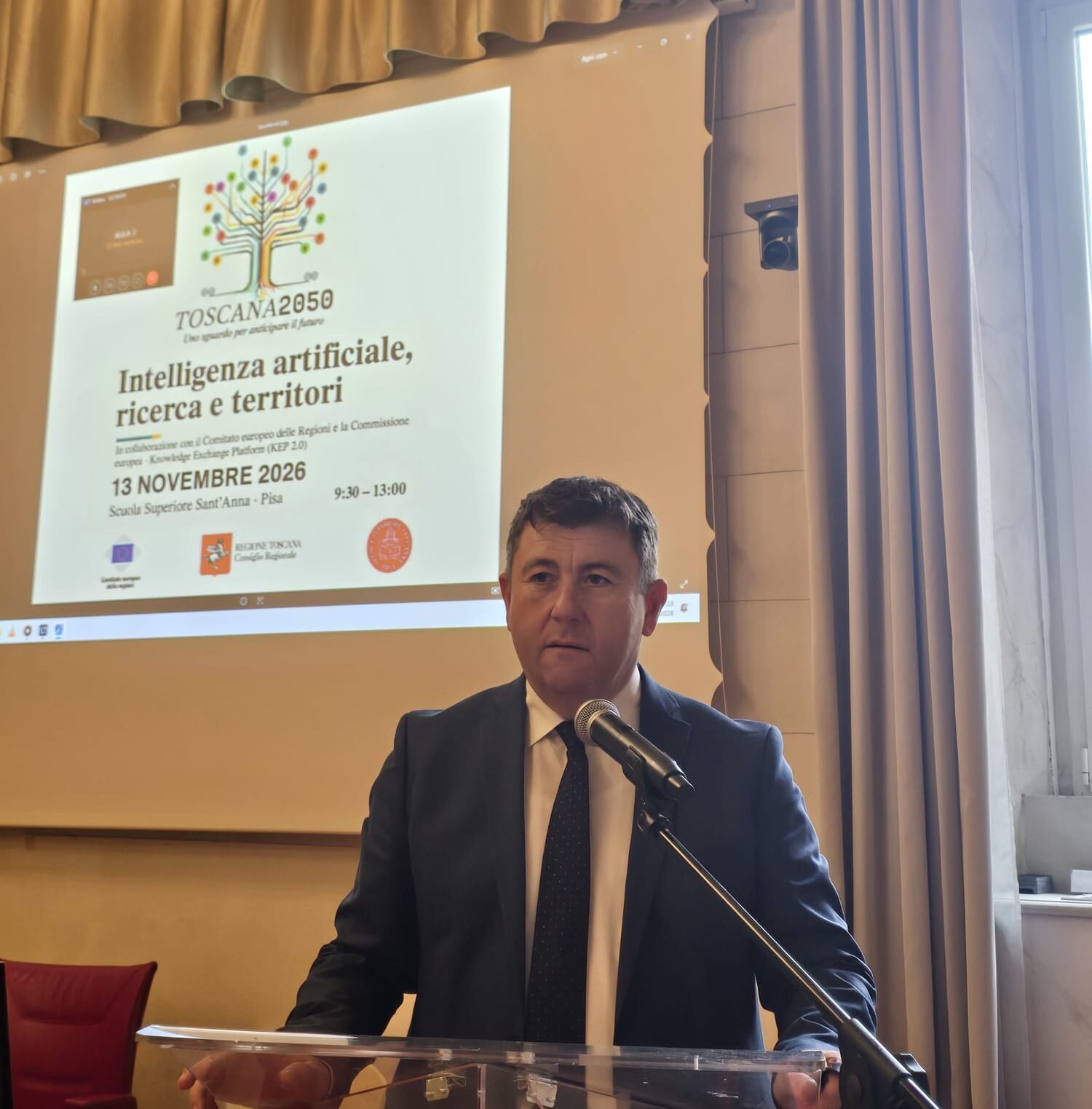
As an invited speaker in the first panel of the KEP event in Pisa on 13 November, I brought the perspective of smaller towns, rural communities and regions still closing development gaps. My contribution focused on a practical question: how can European research and AI create opportunities beyond the strongest innovation centres?
Hosted by Antonio Mazzeo, Vice President of the Regional Council of Tuscany and fellow member of the European Committee of the Regions, the event connected AI, research and public value with a wider discussion of work, business and society towards 2050. That horizon concerns today’s children and the lives they will build as adults.
What I asked for
In my contribution, I stressed the need for practical training for teachers, small businesses and local public staff. I called for partners who can help communities turn local needs into useful projects, and for AI opportunities to reach rural communities as well as large cities.
Not every region needs a major AI centre. Every region needs access to knowledge and expertise. I will continue working towards lasting cooperation between research institutions, education, business and local authorities, including through KEP.
The practical direction I advocate is to start with a real local need, identify partners and prepare training or a carefully defined pilot. This is a proposed next step, not a claim that funding or a partnership agreement has already been secured.
Strengthen people, not dependence
The panel raised an important distinction: replacing people is not the only possible path for AI. Design, incentives and political choices influence whether technology develops human capability or encourages dependence and loss of skills.
Building on my education policy work, I support training that helps people use AI critically and question its output. Rural communities and users of minority languages must not be afterthoughts.
Public institutions also need meaningful human oversight. Technical transparency is not the same as a useful explanation. A public official must be able to understand and challenge a recommendation, rather than simply approve it automatically.
Research partnerships should address specific needs
The debate underlined that AI is wider than generative applications. Specialised approaches may help address particular industrial or public service problems. Their value must be tested against real needs, appropriate data and clear safeguards.
Long term ambition requires sustained cooperation, but not a blank cheque. Milestones, evaluation and attention to environmental and energy costs are essential.
My prepared amendment proposals on Single Market rules and procurement support a related direction: consider cumulative administrative burdens, improve practical procurement capacity and involve local and regional authorities in controlled innovation testing. These remain proposals, not claims of adopted legal change.
European representation must lead to local action
Different views were expressed in Pisa. Some contributions emphasised rights and human capabilities; others called for more investment and a willingness to take research risks. The discussion should not be presented as a single agreed European blueprint.
My position is that competitiveness and cohesion must reinforce each other. Europe needs excellent research and routes for more territories to participate in its benefits. Exclusion can weaken trust; manipulation can exploit divisions. Different political opinions must never be treated as proof of manipulation.
The proposed EU budget for 2028 to 2034 makes meaningful territorial involvement in investment planning particularly important. The final arrangements remain under negotiation. Access to funding requires preparation, not assumptions.
I advocate local plans looking at least ten years ahead, with partners, responsibilities and realistic financing. My preparatory work in Harghita must be followed by the necessary county decisions. European advocacy and local implementation are complementary responsibilities.
I arrived in Pisa following European Capital of Culture duties in Denmark. Across these different areas, the purpose is connected: to help communities offer future generations a meaningful choice to remain and build a life where they belong.
I came to contribute, ask and propose. I will continue that work. The measure of success will be the opportunities we help communities create, not the number of meetings we attend.
Comments are closed.