Talent is everywhere. Opportunity is not. Closing that gap must be a practical test of the European Union’s next generation of cultural programmes and its future budget.
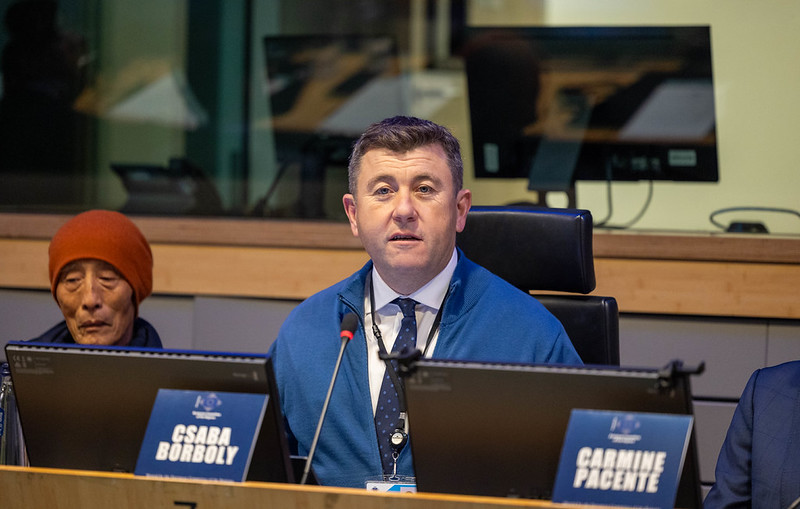
Speaking today at Voices of Peace: Music, Culture, and Mutual Understanding at the European Committee of the Regions, I argued that cultural cooperation must reach beyond established institutional networks and major urban centres. Organised by ICCX, the event brought institutional and cultural perspectives together, with the WuLe Symphony Orchestra represented in the programme.
This was a cultural dialogue, not a budgetary decision meeting. Its relevance lies in connecting a simple message with policy choices: communities need accessible opportunities to meet, create and build trust.
Listening without losing our own voice
Before an orchestra plays, it listens. Musicians tune together without surrendering the distinctive sound of their instruments. That is a useful image for European cooperation.
Our Union does not need uniform identities. It needs the confidence and practical capacity to work across differences. A local choir, library, cultural centre or youth exchange can contribute to that work. Culture is not a substitute for social or economic policy, but neither should it be treated as a decorative addition to it.
Communities need places where people encounter one another as people, rather than as opposing opinions on a screen. Investing in such places is also an investment in trust.
From cultural dialogue to the AgoraEU opinion
On 6 May, the European Committee of the Regions adopted its opinion on AgoraEU, for which I served as rapporteur. The opinion contributes to the legislative process. It is not the final programme regulation, and its recommendations still require sustained advocacy.
A central demand is the recognition of local and regional authorities as implementation partners, with meaningful involvement in governance, monitoring and delivery. Responsibilities should be matched by a voice in shaping the rules.
Another priority is funding that smaller communities and young creators can genuinely access. Formal eligibility alone is insufficient if an applicant lacks administrative capacity or the networks needed to form a partnership.
The opinion also calls for territorial participation indicators and evaluation criteria linked to cohesion and civic engagement. Programme success should not be measured only by the number of funded projects. It should also be assessed by who can participate and which communities remain absent.
Support for cultural cooperation across borders, town twinning and youth exchanges follows the same logic. Europe becomes tangible when young people can work and create together. Clear accountability, transparency and expenditure traceability are equally important. Wider access must be accompanied by responsible delivery.
Not an East against West argument
These challenges are visible in Eastern Europe, but they are not exclusive to it. A small municipality, remote island or mountain community in the West may face comparable barriers. Shared challenges create the basis for shared solutions.
The aim is not to divert resources from one region to another through political rivalry. It is to ensure that programme design recognises different starting conditions and gives prepared local initiatives a credible route to participation.
Europe should not develop two cultural realities: one with strong institutions and international access, another expected to preserve its heritage without the means to renew it. Linguistic and cultural diversity should be supported through practical opportunities, not only celebrated in speeches.
The next MFF makes local preparation urgent
The proposed Multiannual Financial Framework for 2028–2034 remains under negotiation. The proposed National and Regional Partnership Plans make cooperation among European institutions, Member States, regions and local stakeholders particularly important.
They do not mean that national responsibilities disappear or that every funding decision will move to regional level. They make it all the more important to identify local priorities early and ensure that they are represented in national planning.
AgoraEU is one part of this wider landscape. Cultural cooperation, vocational learning, innovation, research and enterprise development may require different instruments. Credible preparation means matching each objective to the appropriate programme rather than expecting a single fund to do everything.
Local authorities can begin now by mapping needs, identifying partners and developing realistic project pipelines. A cultural institution and a school might prepare a youth exchange. Traditional craft practitioners might work with training providers and counterparts abroad. Such ideas are preparation pathways, not announcements of secured funding. Final eligibility will depend on the adopted rules and calls.
What should the next generation inherit?
The decisions being prepared today will shape opportunities well beyond the budget period itself. We should leave young people more than a promise that someone will eventually consider their community.
They should inherit trust, respect and the ability to cooperate. They should be able to maintain their language and cultural identity while building relationships across borders.
That is why regional participation matters before the rules are finalised. It is also why European advocacy must be followed by practical preparation at home. Listening is the starting point. Joint work is what turns it into lasting opportunity.
Comments are closed.