
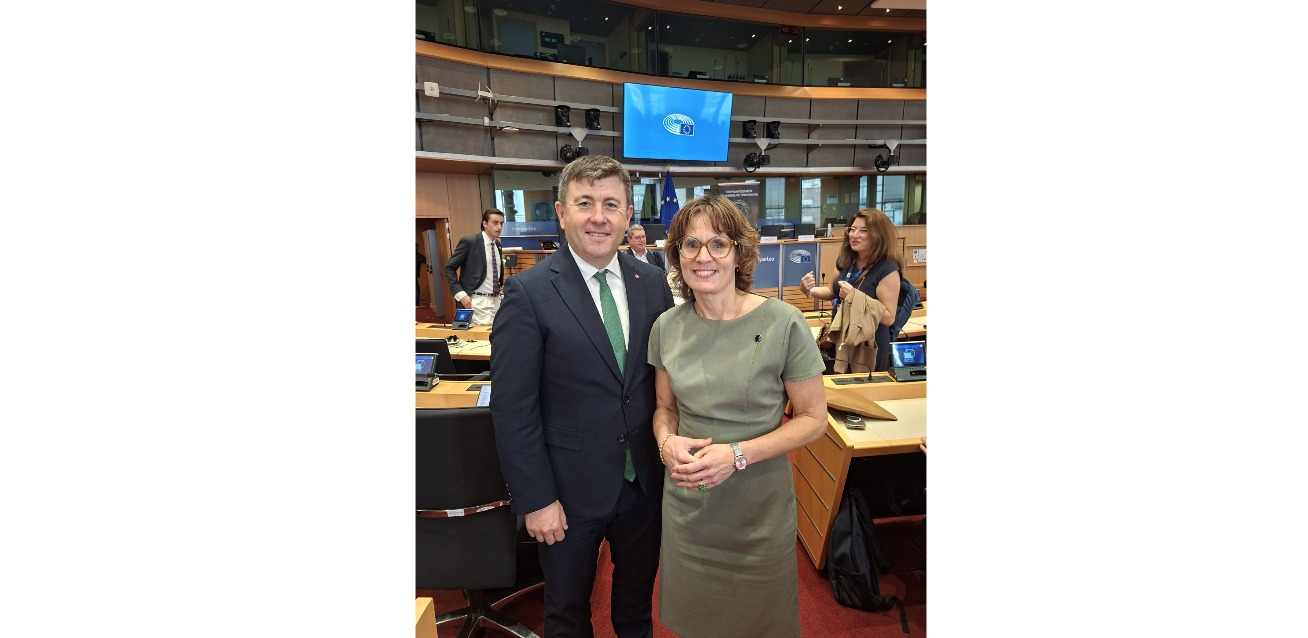
The future of European nature policy was discussed at the European Parliament during an event hosted by MEP Juan Ignacio Zoido, President of the Intergroup on Biodiversity, Hunting and Countryside, and co-organised by FACE and the European Landowners’ Organization (ELO).
European Commissioner Jessika Roswall attended the debate and listened to the contributions from European institutions, professional organisations and affected regions. I presented the positions already adopted by the European Committee of the Regions. In a clearly separate part, I also presented the experience and proposals of the Harghita County Regional Platform for Large Carnivores.
After the event, a small meeting of four people took place with Commissioner Roswall. I explained the situation in Romania, the difficulties in using the legal options under Article 16, and the risks faced by communities living in areas with high bear populations. The Commissioner found the case important and expressed interest in receiving further information.
This was not a final decision. It was, however, an important opening for continued work.
“Europe must not have one nature policy for regions where coexistence is mainly a theory and another reality for communities where large carnivores enter villages and people face danger. Common European values require common protection for nature and for human life.”
One Europe, different realities
Europe’s nature directives protect a shared natural heritage. This is one of the achievements of the European Union and must be preserved.
At the same time, the conditions on the ground are not the same everywhere. Some regions face declining wildlife populations. Others have recovered or rapidly growing populations, high regional densities and serious conflicts with people.
These differences must not divide Europe into East and West. They must lead to better European cooperation, stronger data and solutions adapted to regional conditions.
Eastern regions should not be asked to carry a larger share of the cost and risk of nature protection without fair support. Western experience in conservation, science and prevention is valuable. The direct experience of Central and Eastern European communities is equally valuable. Europe needs both.
The task is not to weaken common standards. The task is to make them work in all parts of the Union.
Article 16 must work
Article 12 of the Habitats Directive sets the rule of strict protection. Article 16 provides legal options for action when public health and safety are at risk or when serious damage must be prevented.
These options are part of European law. They are not exceptions outside the system. They were created to help Member States respond to different situations on the ground.
In practice, however, the same EU rules may lead to very different results. In Romania, decisions made to protect human life can face long delays, legal disputes and uncertainty. During these delays, local communities remain exposed to risk.
“We do not ask Europe to choose between people and nature. We ask Europe to make sure that its legal system can protect both. A legal option that cannot be used in time is not an effective solution.”
The stress test matters
Andrea Vettori, Head of the Nature Conservation Unit in the European Commission’s Directorate General for Environment, explained that the stress test examines national procedures, different interpretations of the rules, derogations, data gaps, monitoring and the process for adapting the annexes to scientific and technical change.
He underlined that derogations are designed to provide flexibility for different local situations. He also made clear that the Commission is looking at how this flexibility works in national systems and whether it is fully used.
Once the stress test is completed, the Commission will prepare a document that may support future policy decisions by the European Commission, the Council and the European Parliament.
There is no automatic promise of legislative change. But there is a real opportunity to place the experience of affected regions into the official European evidence base.
The stress test must therefore look beyond the formal existence of Article 16. It should examine whether decisions can be made in time, whether the proof required is clear, whether national procedures are fair and whether the same EU rules provide equal protection across the Union.
Data gives regions a voice
Strong European policy requires reliable local information. Every dangerous large carnivore incident should be officially reported. Every emergency call, attack, agricultural loss and intervention should become part of a clear and comparable evidence base.
Official data protects both communities and nature. It supports better prevention, faster action, fair compensation and sound population management.
More than 400 people in Romania completed the public questionnaire linked to the stress test. Their participation helped show that the issue cannot be treated as a marginal regional concern.
The next step is to connect citizens’ reports with official data from local authorities, emergency services, scientists and national institutions. The Commission should support common standards, digital monitoring and open access to reliable information.
European support is essential
Coexistence cannot depend only on the financial capacity of individual municipalities or farmers. The next EU budget should provide predictable support for prevention, compensation, scientific monitoring, rapid response teams and regional dialogue platforms.
Investment in coexistence is an investment in nature, public safety, farming and trust in European institutions.
Regional and local authorities must have a permanent place in this work. They implement European rules and face their direct social impact. Their experience is not a challenge to European nature policy. It is necessary for making that policy successful.
The work continues
The bear issue will not be solved by one meeting or one legal act. It requires continuous cooperation among Member States, the European Commission, the Council, the European Parliament and the European Committee of the Regions.
The immediate goal is to make Article 16 clear, timely and legally strong. The next steps should include common evidence standards, regional monitoring, fair funding and practical guidance for national authorities.
If the present system continues to fail in regions with favourable population status, high density and serious conflict, Europe must also be ready to examine the protection regime on a scientific and regional basis. Moving a population from strict protection to managed protection would not mean ending conservation. It could allow controlled and monitored management while keeping strong safeguards.
A further dialogue is planned in Romania in December. The aim is to bring European institutions, public authorities, scientists, farmers, wildlife managers and affected communities around the same table.
“There must not be two Europes. The same European values must protect biodiversity in every region, but they must also protect the citizens who live with the daily effects of nature policy. East and West must work together, learn from each other and build one system that works for both nature and people.”