Action is needed now in Brussels: counties such as Harghita could lose out
Decisions are being prepared in Brussels these days that could determine for many years whether EU funds after 2028 will truly reach less developed, rural and mountain regions. According to Borboly Csaba, the stakes are clear: if Bucharest plans alone, without local and regional knowledge, counties such as Harghita may be put at a disadvantage.
Brussels is not waiting. Preparations for the new European Union budgetary period are already under way, and the debate around the so-called NRPP system will determine whether development funds after 2028 will genuinely support the catching-up of less developed, rural and mountain regions, or whether large cities and already stronger centres will once again be placed at an advantage.
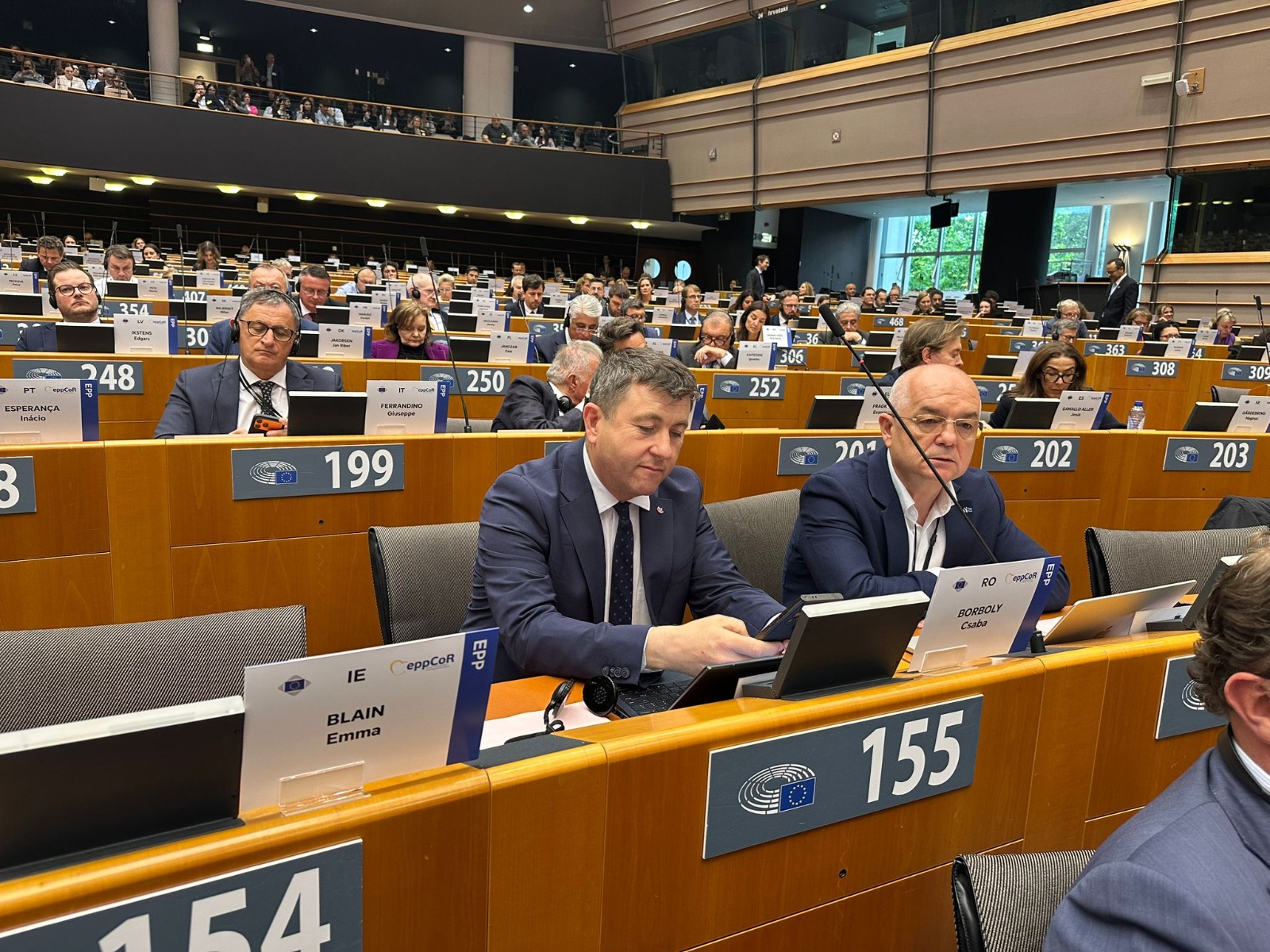
Borboly Csaba, Vice-President of Harghita County Council and member of the European Committee of the Regions, believes this is not a technical debate, but a debate about the future of counties such as Harghita. It is about whether young people will have a future at home, whether new jobs will be created in rural areas, whether wages can improve, and whether depopulation can be stopped in communities from which not everyone can simply move to large cities.
The NRPP, the National and Regional Partnership Plan, is a new planning framework through which Member States would prepare several EU funds for the 2028–2034 period in a broader and more unified system. Based on the draft CoR document and the submitted amendments, one of the greatest risks is that decisions could become excessively centralised, while the local and regional levels would be reduced to a merely implementing role.
According to Borboly Csaba, this is dangerous because Bucharest cannot decide alone what counties such as Harghita, or mountain, rural and lagging regions, actually need. Development needs are not the same in every part of the country, and planning cannot be a standardised exercise imposed from above.
This is why the CoR amendments stress that cohesion, subsidiarity and multi-level governance must not remain mere principles. They must become real practice. Without the mandatory involvement of regional authorities and, where appropriate, local authorities, the new system will be neither credible nor effective.
The stakes are easy for citizens to understand. If future EU calls for projects and development priorities are written exclusively at ministerial desks, without real knowledge of local conditions, programmes may easily be created that fail to address the realities of counties such as Harghita.
In practice, this means that funding may go where the economy is already stronger, institutional capacity is greater, lobbying power is more effective, and administrative response is faster. In such situations, large cities gain new jobs and can offer higher salaries, while people living on the periphery are silently told: move away if you want to make a living.
Borboly Csaba believes this contradicts the very essence of cohesion policy. Its purpose should be precisely to give less developed regions, including counties such as Harghita, a real chance to catch up, create jobs and strengthen the conditions that allow people to remain at home.
The amendments supported by Borboly Csaba point in a clear direction. The regulation must be aligned with the objectives of economic, social and territorial cohesion, as well as with the principles of subsidiarity and multi-level governance. This means that development policy cannot be shaped exclusively according to a central logic, because differences within the country are real and require real answers.
According to Borboly Csaba, it is equally important that, during the mid-term review, the involvement of regional authorities and, where justified, local authorities should be mandatory. Without this, new priorities will not correspond to real territorial needs. The specific disadvantages of less developed, rural, mountain and lagging regions must be taken into account separately, because counties such as Harghita cannot be treated according to the same logic applied to large urban centres.
According to CoR documents, the NRPP Fund Regulation is being discussed at the 171st plenary session, scheduled for 6–7 May 2026. The document approved at committee level received the green light on 5 February 2026, and the plenary vote is taking place during these days.
However, the significance of the decision goes beyond these few days. The rules concern the 2028–2034 period, and if we also take into account the implementation timeframe, the effects of poor planning now may still be felt until 2036 in counties such as Harghita. That is why the current moment is a strategic window: what we fail to include in the system now will be much harder to correct later.
The European Union places fairness and cohesion at the forefront, but these will only produce tangible results if Romania also does its homework. Borboly Csaba is convinced that a good NRPP cannot be a ministerial document prepared by copy-paste. It must be based on real territorial analysis, needs, opportunities and concrete solutions adapted to each area.
It would be a serious mistake if, in places where knowledge, development experience and specialists are available, people were still not allowed to work in time. If the local and regional expertise of counties such as Harghita does not reach government-level planning, the loss will not be borne by institutions, but by citizens.
The fact that one of the co-rapporteurs is Emil Boc, Mayor of Cluj-Napoca, is of particular importance. According to Borboly Csaba, this provides an opportunity for the message to be conveyed more strongly from a Romanian perspective as well: the local and regional levels cannot be excluded from the work that will define the development framework for the coming years.
However, this alone is not enough. Decision-makers in Romania must also understand that success does not begin when a funding guide is published. Success begins where the rules, priorities, eligibility criteria and territorial focus can still be influenced in time. That moment is now.
Borboly Csaba underlines that the goal is not for common European funds to go to other countries, nor for the same large cities within the country to once again attract opportunities at the expense of rural areas. The goal is for the distribution of funds to be fair, place-based and future-oriented, and for counties such as Harghita to receive real tools for catching up.
This is why he raised this issue in Brussels, why he supported amendments in the European Committee of the Regions, and why he is calling for action now, while the decision-making windows are still open. Brussels is not waiting, the days are passing, and opportunities missed now may limit the development space of less developed regions such as Harghita County for many years.
Brussels, 6 May 2026