Harghita County for Equal Opportunities, from Brussels to Miercurea Ciuc
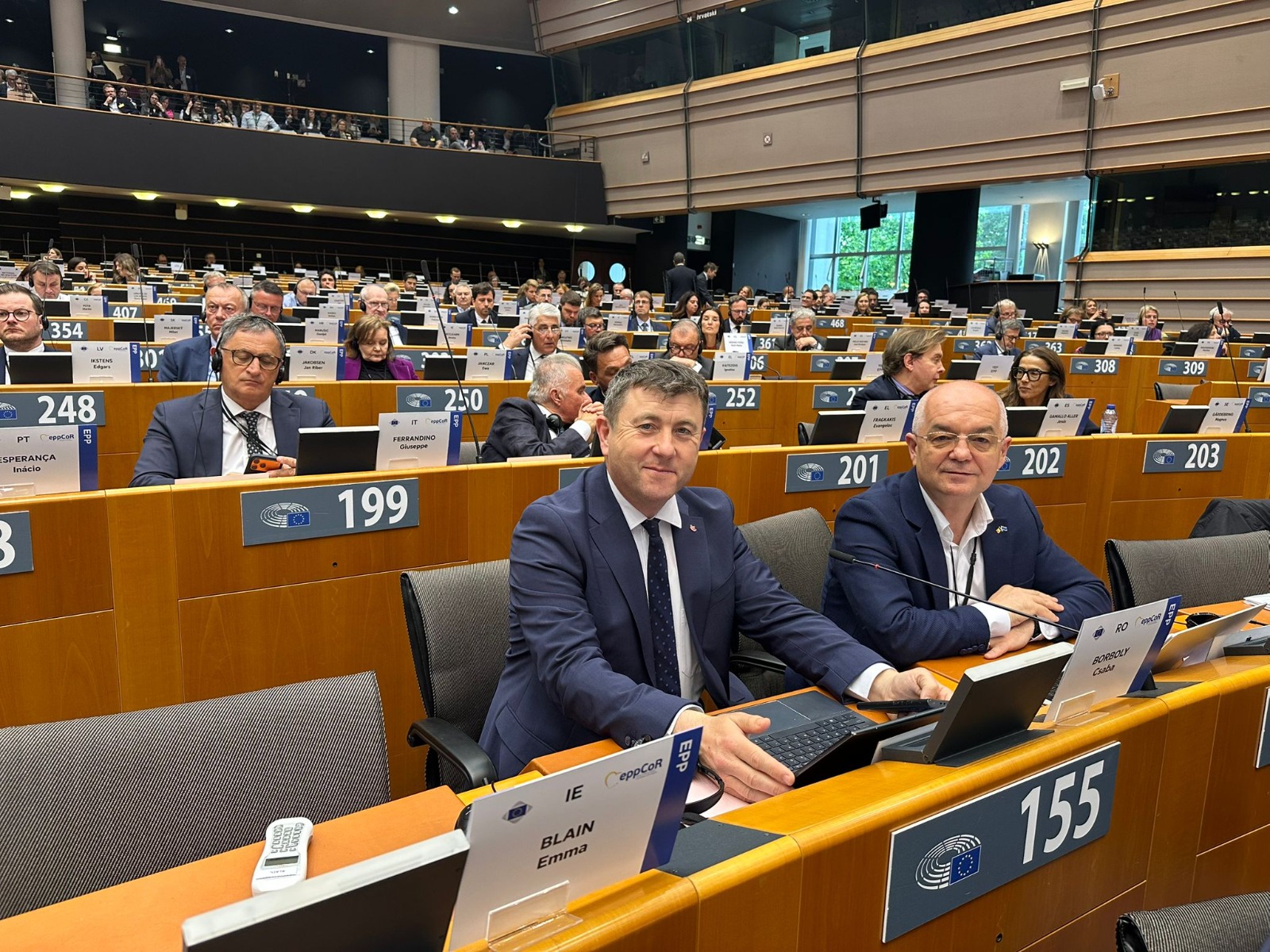
Today in Brussels, the plenary session of the European Committee of the Regions is voting on rural development policy after 2028. Harghita County has brought eight amendments to this table. Behind each of them lies a real-life situation: a mountain farmer who cannot compete; a young person who moves away because there is no other option; a community that pays out of its own pocket for the consequences of EU nature conservation policy.
This news is about what is happening now — and what can change if we dare to act.
May 6, 2026
Why are we not competitive? Because we are not starting from equal conditions
Harghita County is a mountainous, less-developed, biologically diverse area. In EU documents, these three words count as virtues. In everyday life, they are a burden.
The example of milk: In Romania, the EU coupled support for one dairy cow is about 330 euros per year. In Poland, the same support is 635 euros — almost twice as much. Polish milk is produced at a lower cost and appears on the shelves of Romanian shops at depressed prices. Romania’s raw milk imports increased by 38.7% in 2024 in a single year. The farmer in Harghita receives 1.20–1.80 lei per litre — while this barely covers production costs.
The example of potatoes: In 2025, potato production in Harghita County fell by 35% due to weather anomalies, with average yields barely reaching 18.5 tonnes per hectare. In the same year, the price dropped by 40% — barely covering production costs.
The example of large wild animals: Last week in Lupeni, the body of a 65-year-old local man was found in the forest — with bear-bite marks. This is not the first case, and it will not be the last if decision-makers do not dare to act. Caught between Romanian and EU legislation, local authorities are powerless. EU nature conservation directives serve important goals — but they cannot come at the expense of human life. Where governments are afraid to act, local people pay the price.
The root of the competitive disadvantage is not our fault. In mountainous areas, infrastructure costs are higher, access is more difficult, service provision is more expensive — and on top of all this, fewer resources are allocated than to the country’s lowland areas.
What did we take to Brussels? Eight amendments, eight concrete messages
We submitted eight amendments to Opinion NAT-VIII/019 of the Committee of the Regions — “The Future of Rural Development 2028+”. These are not technical texts: each amendment has a real impact on how EU funds will be distributed after 2028.
What we asked for What this means for Harghita
- Mountainous and less-developed regions should receive priority in resource allocation Harghita County could receive more development funding under the NRP
- EU-level funding should be allocated for managing large-wildlife damage Bear and wild boar damage should not be borne by farmers or the county alone
- Food production capacity and crisis preparedness should be part of territorial resilience Harghita’s dairy farmers and potato growers should receive EU-level protection
- Local food systems and short supply chains should receive explicit support Local processing of Harghita milk and potatoes could become fundable
- Mountainous, extensive livestock farming should receive a targeted support scheme Red-and-white cattle breeding, sheep farming and mixed farming could survive
- Counties should be involved in the rural-proofing process Harghita County could have a direct say in the content of Romania’s NRP plan
- Young farmers should receive integrated support: land + housing + local services Young people should receive not only promises, but the conditions needed to stay
- Rural culture should be a joint target area of AgoraEU and the NRP Harghita’s cultural life — celebrations, heritage and local identity — could access EU funding
The political window: Barna Tánczos and the temporary opportunity
The RMDSZ currently leads the Ministry of Agriculture. This is a narrow but real window — and such windows close quickly.
Three immediate steps are possible now, each with lasting impact:
Increasing coupled support for milk production. The European Commission’s 2025 CAP Omnibus simplification package provides flexibility for Member States to modify CAP Strategic Plans. Romania could increase the current approximately 330-euro coupled support for milk production — bringing it closer to the Polish level of 635 euros and reducing the competitive disadvantage. The deadline for submitting the amendment is summer 2026.
Examining the competitive impact of imported milk. Romania’s raw milk imports jumped by 38.7% in a single year. The Ministry of Agriculture — with the same level of preparation as the RMDSZ experts applied in drafting Law 122/2023 on pig farming — could launch an internal analysis and notify Brussels about the competitive impact of unequal support levels.
Involving Harghita County in the NRP consultation process. Romania’s National and Regional Partnership Plan must be submitted in 2027. If the ministry now records that Harghita County will participate in the planning as a consulted party, mountain-area considerations will be included in the final plan. If this does not happen now, the next negotiations may no longer have an RMDSZ hand at the table.
Political truth: A well-built, data-backed proposal submitted to one’s own ministry is ten times more effective than the same proposal handed to a stranger.
Why are young people leaving — and what can be done about it?
Outmigration is not accidental and not inevitable. It has concrete causes — and it can be stopped through concrete interventions.
Young people in Harghita see that:
There is no accessible land for farming — older farmers do not release it, and there is no intermediary.
There is no affordable housing in villages and small towns.
Digital infrastructure is lacking — in many places, one cannot run a business without stable internet.
Import competition makes dairy farming and potato production unprofitable.
This is why, in the amendments, we asked that young people receive not only participation rights in rural development plans, but an integrated package: land + financing + housing + local services. Because the right to stay means nothing if the conditions are missing.
According to the European Commission’s own analysis, the share of young women in rural areas of the EU is the most critical: only 4.2% of farmers are women under the age of 35. This figure is no better in Harghita County. If young people leave, population decline cannot be stopped.
The bear: balancing nature conservation and human life
Last week in Lupeni, Harghita County, the body of a 65-year-old local man was found in the forest — with bear-bite marks. He disappeared on April 27 and was found on May 4.
This is not the first such case, and it will not be the last. The European Union’s nature conservation directives — above all the Habitats Directive — protect important goals. But where the balance of implementation is lost, and no one guarantees the safety of local people, the purpose of the directive itself is also harmed.
The Romanian government has hesitated for years to resolve the management of large-wildlife populations — not because it is unable to act, but because it fears the legal consequences. In our amendments, we therefore asked that the human and economic costs caused by the presence of large wild animals be explicitly recognised in EU funding allocation — and that the situation faced by Harghita farmers, who struggle with both bear damage and bureaucratic obstacles, become manageable.
The protection of nature and the protection of people are not opposites. But if neither is achieved without political courage, both lose.
Harghita County Council’s Rural Development Association: the link between Brussels and the Harghita farmer
Amendments in Brussels do not reach the farmer in Lupeni, the young entrepreneur in Gheorgheni or the dairy producer in Miercurea Ciuc by themselves. For that, an institutional link is needed.
Harghita County Council’s Rural Development Association — as the legal successor after ADEHAR ceased operating in 2023 — fulfils this role. The Association inherited 670 business contacts and a project background worth 2.5 million euros. It has worked for six years with the Székelyföld Red-and-White Cattle Breeders Association — on milk control, the genetic register, grant support and laboratory costs.
This work can continue only as long as the institutional background remains stable. For this, the 2026 membership fee is necessary.
The Association is also coordinating the mid-term review of Harghita County’s rural development strategy, which must be completed by September 2026 — and without which the county’s interests will not appear in Romania’s NRP plan.
The message, simply put
Harghita County is not falling behind because people do not work hard enough. It is falling behind because it has to compete under unequal conditions.
The Polish dairy farmer receives twice as much EU support — and his product ends up on the shelves of shops in Harghita.
Maintaining mountain infrastructure costs more — but receives less funding.
The local person bears the cost of wildlife damage — the price of EU nature conservation policy.
The young person would like to move home — but there is no land, no housing and no predictable livelihood.
All of this can be changed. But for that, we need representation in Brussels, political courage in Bucharest, and a functioning institutional system at home.
Today, we are working to ensure all three.
Miercurea Ciuc, May 6, 2026
Csaba Borboly
Vice-President of Harghita County Council | Member of the European Committee of the Regions | President of the Rural Development Association of Harghita County Council