For AgoraEU inside, for farmers outside – today in Brussels we worked for the same future
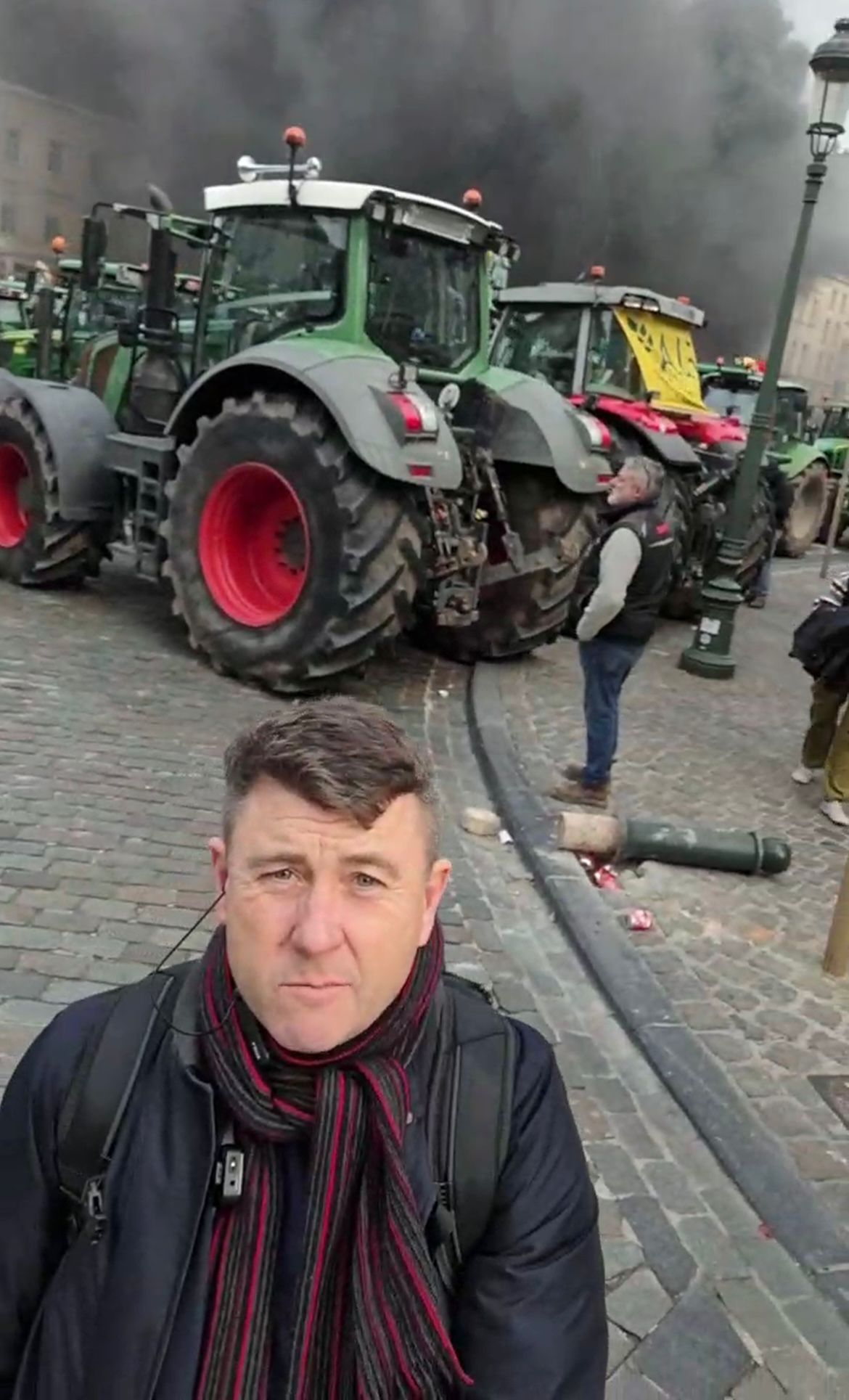
Representatives of farmers from Ciuc and Harghita County were also present in Brussels; I supported them at the protest.
Today many people asked me: why did I have to be in Brussels when, back home in Harghita County, the year-end evaluation of mayors was taking place—an event where I would have liked to be present myself.
The answer is simple, even if it is not comfortable: the EU’s 2028–2034 financial period is taking shape right now, and those who are not present in the antechamber of decisions at such moments will later only look at “how the menu turned out” — without having written it themselves. Today was about ensuring that Harghita County, Szeklerland, and the Hungarian communities of the Carpathian Basin have real chances: access to funding, visibility, cultural and civic strength, and the respect they deserve.
And yes: while many people were “raising a glass” today, I did not — partly because there simply was no time, and partly because I do not wish to bring home a Ciuc–Odorheiu–Gheorgheni virus package as a gift. (Those who know me understand: if it’s a gift, let it be additional funding, not additional coughing.)
Why couldn’t I be at home with the mayors today?
The mayors’ year-end evaluation is important. It is important to me personally as well — it is where we see what worked, what did not, and where we need to turn our focus in 2026. I would have liked to be there.
However, today’s Brussels meeting did not come up yesterday: this appointment was scheduled well in advance. And there is one sentence that cannot be repeated often enough: credibility as a rapporteur in these circles can be lost only once. If you are not there when it matters, the next door opens only halfway.
Moreover, what we are discussing today in Brussels is not a “distant Brussels issue”: it is a series of decisions that we will encounter at home in 5–6 years — in application conditions, available support, administrative requirements, and ultimately in who has opportunities and who does not.
AgoraEU: why is it important for me to be “inside” an EU institution?
Today, at the stakeholder consultation, we discussed AgoraEU — the framework that in the coming period may provide larger and more coordinated support for culture, media, values, citizenship, youth, and civic courage.
My message today was the same as always:
- Simplification — yes; centralisation — no.
- Subsidiarity — yes; “one size fits all” — no.
- Local and regional actors should not be merely “beneficiaries,” but real partners, because culture and democracy live locally: in towns, villages, and communities.
I needed to be here because resources must be brought to Harghita County, to Szeklerland, and more broadly to Hungarian programmes across the Carpathian Basin:
for culture, heritage protection, media, and the valuable work of our civil organisations.
Today I also held discussions with key stakeholders, including:
- Ms Sneška Quaedvlieg-Mihailovic – Secretary General of Europa Nostra (present in person)
These meetings are not “protocol photos.” They are bridge-building efforts: alliances, arguments, partnerships. Because if we want peripheral regions to have real opportunities in 2028–2034, the rules must be set now, so that not only “the big players” win again and again.
UDMR: we are few, but we work as a team — at home and in Brussels
Here comes an important, often invisible dimension: this is not a one-person job.
Within UDMR we are few, yet we work as a team: locally, in Parliament, in government, and here in Brussels as well. Too often in Romanian politics the biggest disadvantage is haste and ad hoc decision-making. In contrast, we coordinate, seek allies, and consistently represent a clear direction.
Not because it is easy, but because when you are few, you must build majorities more intelligently: with arguments, partnerships, and consistency at every level.
This is important for Romania as well: without a strategy, you get “whatever happens” — and then you have to cook from whatever is at hand. I was here today to ensure that we do not simply drift along, but actively shape what is coming.
Protest in Brussels: for farmers outside, for the future inside
Today there was also a protest in Brussels, and yes: representatives of farmers from Ciuc and Harghita County were present. I supported them.
Why? Because what they represent is not a “sectoral grievance,” but a way of life, continuity, and the future of the landscape. They are standing up so that the value they produce is not crushed by an over-bureaucratised system of rules, while the market is distorted by cheap imports, often arriving under unfair competitive conditions.
And here comes the core message of the day:
between culture–media–civic courage and agriculture there is more in common than one might think at first glance.
Rural farmers do not only produce food. They:
- pass on values and traditions from generation to generation,
- preserve gastronomy, the beauty of the landscape, and community patterns,
- and through traditional farming maintain a liveable, diverse landscape.
This must not be dismantled.
That is why it is entirely compatible that on the same day I work “inside” on the 2028–2034 framework, while they work “outside” so that from 2028 onward life in rural areas can be better. The fact that I was in the building of an EU institution today does not mean that I chose the other side of the barricade. I chose the same thing as our farmers: a future, continuity, and fair rules.
We are one team.
Some stand in the street. Others argue over the rules inside.
The goal is shared: that from 2028 onward things are better, not worse, for our children.
What do I take home from this day?
The next European Union is taking shape at supersonic speed, and those who do not prepare will be left with a vague “something will happen.” We must not react ad hoc, but keep a clear direction: values, heritage, culture, community, rural areas, young people, civic strength.
That is what I worked for today — even if I was not at my best. We cannot stop, because the stakes are high: respect, resources, opportunities.
Thank you for the understanding also to those who missed me at home in Harghita County today. This day was not an absence, but an investment: so that what can be launched today in Brussels will be visible tomorrow at home as well.
Brussels, 18 December 2025
