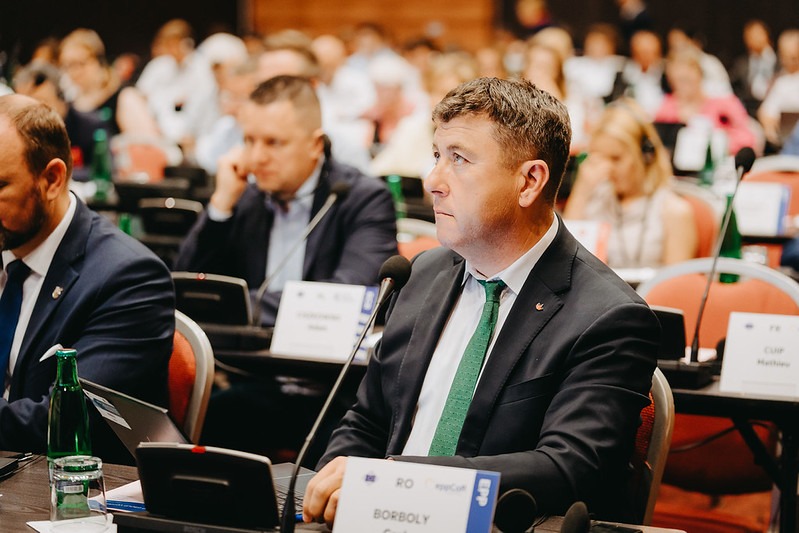
On 22 June 2026, the SEDEC Commission of the European Committee of the Regions held its ninth meeting in Trnava, at an away session. The agenda included the debate on the draft opinion on the New European Bauhaus. Csaba Borboly, Vice-President of Harghita County Council and full Member of the Committee of the Regions, saw all his submitted amendments accepted by the commission. The rapporteur integrated the proposals. The commission approved them by vote. This is a remarkable result with a direct impact on the future of Harghita County.
What is the New European Bauhaus?
The European Commission adopted the New European Bauhaus programme at the end of 2025. It is built on three principles: sustainability, beauty and inclusion. Its aim is to renew Europe’s built environment — energetically, culturally and in community terms. The Committee of the Regions is now preparing its own opinion, which will be finalised at the October plenary session. This opinion will enshrine the principles on which EU funding can be mobilised in the next programming period.
What was adopted? What does it mean for Harghita and similar counties?
Mountain and rural perspectives become mandatory. The adopted text states that all NEB instruments and funding criteria must also be assessed from a mountain and rural perspective. Regions such as Harghita County will no longer be able to be excluded from NEB funding.
The concept of biocultural area enters the EU programme. This is one of the most important results. A biocultural area is a rural territory where the natural environment and the local economy coexist in harmony, deeply embedded in the culture and tradition of the community. Harghita County — with its forests, traditional Szekler landscape and agricultural culture — is exactly such a territory. The adopted text provides that biocultural areas must appear as a distinct category within the NEB framework, with their own eligibility criteria and NEB certification.
Timber as a renewable building material — local value chain. In 2024, Csaba Borboly studied together with designers, wood industry engineers and foresters from Harghita at the Joint Research Centre of the European Commission in Ispra: timber is one of the most important building materials of the coming decades. Cross-laminated timber can bear the load of entire buildings as a modern structural element and sequesters carbon for decades. The adopted amendments state that the NEB must actively support local timber value chains — from the forest through local processing to the finished building. This simultaneously represents a climate solution, a circular economy development and local job creation in mountain regions.
Built heritage of minority communities. The adopted text explicitly names the built heritage of national and linguistic minority communities — from Szekler farmsteads to Armenian churches — as an irreplaceable part of European architectural diversity. These will be eligible for NEB certification and NEB support.
Retaining young people, strengthening small settlements. The adopted amendments transform the NEB Boost programme for small municipalities into a permanent instrument. Demographic revitalisation and retaining young people in their communities must become mandatory criteria.
Why is this result special?
Getting a member’s amendments accepted in the Committee of the Regions is not an automatic process. The commission is politically diverse. All twelve amendments received a positive vote. These principles have become a pan-European consensus. They will be included in the CoR’s official opinion. The European Commission and Member States will take them into account when planning programmes.
The timber industry opportunity: the decision must be made now
Harghita County was once one of the strong centres of the Transylvanian timber industry. 15 percent of the workforce worked in the forestry and timber sector. Today that proportion has shrunk to a negligible level. The majority of enterprises went bankrupt. Jobs disappeared. The county’s valuable timber leaves the region standing or as logs — without processing, without added value and without local jobs. Forest owners and communal forest associations face growing difficulties due to windthrows and unpredictable market conditions. Expectations among members are enormous: something must change.
The New European Bauhaus programme, the associated EU funding instruments, LEADER, the cohesion funds and Horizon Europe are together capable of rebuilding the local timber value chain. A strategy is needed. Sectoral consultations are needed. Place-based planning is needed. Precisely what Csaba Borboly proposed in autumn 2025 and at the beginning of 2026 to the President of Harghita County Council: to receive coordination competences, to establish a sectoral consultation process and to develop a jointly elaborated vision. That proposal is still awaiting a response.
What comes next?
The CoR plenary session on 12-13 October will finalise the NEB opinion. NEB Boost funding rounds for small municipalities will then open. NEB Academy training programmes in timber construction must be launched in 2026-2027. Horizon Europe funding lines for biocultural areas open in 2027. In the new EU programming period starting in 2028 the NEB principles will be integrated into the cohesion funds.
The European framework exists. The decision is in Harghita County’s hands.
Csaba Borboly | Vice-President of Harghita County Council | Full Member of the European Committee of the Regions | Member of the SEDEC Commission