Csaba Borboly attended the European Committee of the Regions Conference — and brings home a message that demands immediate action
Today, Something Fundamentally Changed in Europe
The European Union opens a new chapter in 2026.
It is not Brussels that decides how Hargita County develops.
Not Bucharest.
Not Berlin.
The new European principle is called: „Right to Stay”.
It means every European citizen has the right to live, work and grow old where they call home.
They should not have to leave because there are no jobs.
They should not have to leave because there is no adequate healthcare or schooling.
Migration must be a free choice — not a necessity.
This principle applies to every rural region in Europe.
If we choose to claim it.
What Happened in Trnava Today?
The European Committee of the Regions held a conference in Trnava, Slovakia.
The topic: how to apply a place-based approach to innovation across rural and metropolitan regions.
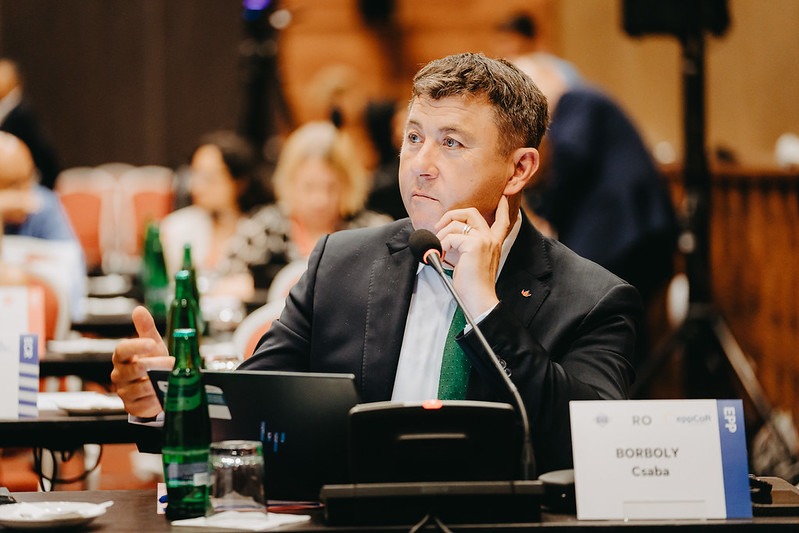
Csaba Borboly, Vice President of Hargita County Council and Member of the European Committee of the Regions, attended and intervened.
Speakers included an expert from the European Commission’s Joint Research Centre (JRC) in Seville, the Vice Chair of the European Parliament’s REGI Committee, and a Senior Councillor from the OECD.
They all said the same thing in different words:
The next EU financial framework from 2028 will only benefit regions that are ready now. Those who wait will fall behind.
What Does „Place-Based” Mean and Why Does It Matter?
Simply put: you cannot apply the same solution in a rural Carpathian mountain county as in Bucharest or Hamburg.
Hargita County is a mountainous, rural region with its own culture and economic structure.
Our strengths are different.
Our challenges are different.
The EU now recognises this and builds policy on it.
Place-based development means local governments, local businesses, local universities and local communities plan together what they need.
They are not handed a solution from above.
They build it themselves — and the EU funds it.
This is the only method through which rural regions can genuinely benefit from EU funds.
What Do the Data Show? JRC Put Numbers on the Table Today
The debate has long discussed the divide between rural and urban areas.
The JRC Startup Village Forum research presented concrete evidence today.
The result is striking.
When we look at patents and R&D expenditure, the urban-rural gap is large.
But when we look at what share of companies introduce new or improved products, processes or services — real, everyday innovation — the gap is much smaller.
64% of rural companies in Europe innovate in some form.
In urban areas, that rate is 70%.
This means: rural innovation exists. It is simply different. Not patents — adaptation. Not laboratories — local knowledge.
The JRC research also showed that the main obstacle for rural companies is not talent.
It is the local and national tax environment — and access to finance, which today is largely concentrated in cities.
The solution: local clusters, local financing channels and institutions that bring actors together.
This is exactly what rural regions need — and what they are capable of.
The Stakes: Numbers That Do Not Lie
The European Commission plans 450 billion euros for cohesion in the 2028-2034 period.
Of this, at least 218 billion euros is allocated to less developed regions.
Hargita County is a less developed region.
In principle, it qualifies.
But the money does not arrive automatically.
Only regions with an up-to-date strategy, a demonstrated local partnership and active participation in EU negotiations will receive it.
If regions are not ready, national capitals will decide.
National capitals’ priorities do not always align with regional needs.
No External EU Border? That Is Not a Weakness — If Managed Smartly.
The OECD expert highlighted something particularly important for regions without an external EU border.
Many European regions rely on cross-border programmes for development.
Hargita County has no external EU border.
This does not mean it should be excluded from place-based development logic.
It means it must take a different path.
That path is building internal territorial capacity.
It means: a strong local institution that brings together farmers, entrepreneurs, universities and local governments.
Once that is in place, the region can seek partners in similar European regions — not based on geography, but on shared interests and common challenges.
The OECD’s Tuscan example shows: the best innovation partner is not always the neighbour.
The Right to Stay only becomes real if the reason to stay also exists: paid employment, entrepreneurial opportunity, local perspective.
That is what place-based development actually creates.
Three Things Are Happening in Parallel — and Cannot Wait
- Negotiations on the 2028 cohesion regulation are happening now.
What is not included now will not change for 7 years.
If regional perspectives are absent from national partnership plans, funds will be distributed according to central government priorities. - The „Right to Stay” strategy is being shaped now.
The European Commission is collecting regional experiences right now.
Every intervention counts.
Those who stay silent will not be represented. - The EIB financing window is open now.
Funding is available in 2026 for the Romanian public sector — for those who come prepared.
The Message from Trnava
The question is not whether the EU will help rural regions.
The EU wants to help.
The system is built for this.
The money is allocated for this.
The question is: are we ready?
The new EU framework is not about capitals or central governments.
It is about places and people.
About us.
If we choose to act.
The Right to Stay will only be real if we ourselves fight for it.Those who stay silent will not be heard.
Trnava, Slovakia — 23 June 2026