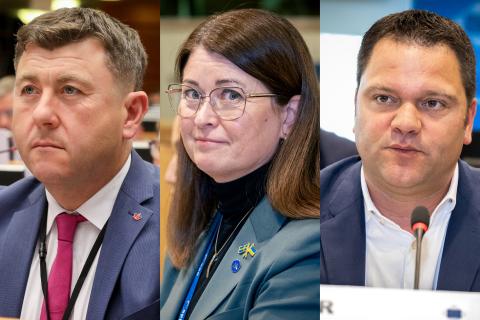
Borboly Csaba, Vice-President of Harghita County Council and EPP-CoR shadow rapporteur on the opinion concerning the Environmental Implementation Review and the simplification of EU environmental policies, emphasized that Europe’s green objectives can only be achieved if local and regional authorities are provided with the tools, funding and flexibility needed to implement them effectively on the ground.
“Europe’s green objectives can only be achieved if local and regional authorities are given the tools, funding and flexibility needed to deliver them on the ground”
said Borboly Csaba.
The Vice-President of Harghita County Council drew particular attention to the specific situation of rural and mountainous regions. In these areas, he said, biodiversity objectives must be reconciled with the safety, livelihoods and long-term presence of local communities.
Borboly Csaba stressed that conflicts caused by the growing population of large carnivores and the difficulties of human–wildlife coexistence cannot be ignored.
“Where wildlife damage and human–wildlife conflicts lead to land abandonment, we lose precisely those farmers whose presence maintains the grasslands and meadows Europe wants to protect. This is not a contradiction we can afford to ignore”
he underlined.
Referring to the case of Romania, Borboly Csaba recalled that a nationwide scientific study based on genetic analyses estimated the brown bear population at more than 12,000 individuals, while at the time of Romania’s accession to the European Union approximately 4,000 bears were reported. He called on the European Commission to assess what conclusions should be drawn from such documented cases of overpopulation for the future implementation of EU nature protection legislation.
During the debate, several speakers emphasized that European environmental rules must be better adapted to local realities. Åsa Ågren Wikström, County Councillor of Västerbotten Region, spoke about the importance of greater coherence between water-related legislation, particularly between the Water Framework Directive and the Urban Waste Water Treatment Directive. She stressed that pollution must be tackled at source, and that effective monitoring of micropollutants is essential to protecting citizens and the environment.
Thibaut Guignard, Mayor of Plœuc-l’Hermitage, pointed out that the green transition must be implemented together with local communities, not against them. According to him, simplification must not mean weakening Europe’s environmental ambitions, but rather creating rules that are clearer, more applicable and fairer.
In conclusion, Borboly Csaba emphasized that regions and local authorities are ready to contribute to achieving Europe’s environmental objectives, but they need European policies that take local specificities into account.
“Europe’s environmental objectives will succeed only if implementation is practical, fair and place-based. Regions and local authorities are ready to deliver, but they need European policies that recognise their realities and support them with the necessary resources”
said Borboly Csaba.