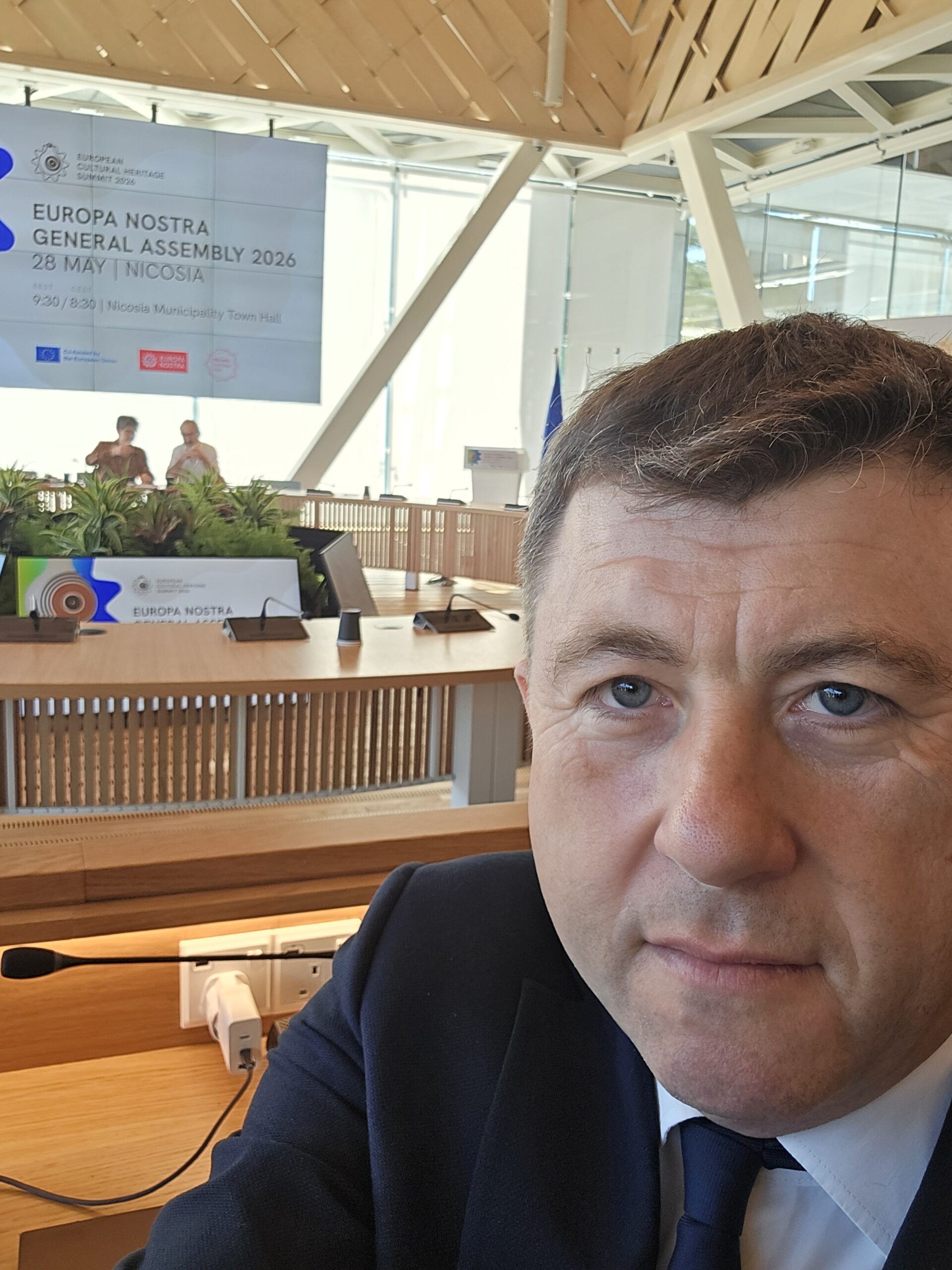
This morning I addressed the General Assembly of Europa Nostra in Nicosia, Cyprus — at the European Cultural Heritage Summit, where everyone who matters in European heritage has gathered: ministers, EU Commissioner, heritage professionals, award laureates, and policymakers.
From Cyprus, I send a message home — to regional and local authorities across Europe, to policymakers, and to everyone for whom our built heritage, traditional crafts and local cultural values are not museum exhibits but a living community reality.
The message is simple: 2026 is a historic opportunity. But only for those who work today.
What Was Achieved in Brussels: AgoraEU and What It Means
On 6 May 2026, the European Committee of the Regions unanimously adopted my Opinion on the AgoraEU programme — the foundational document of the EU’s most important cultural programme for 2028–2034, with a budget of €8.58 billion.
What was secured — and why it matters for regions and cultural heritage organisations across Europe:
Living heritage and traditional crafts became a standalone priority. Not in general terms, but explicitly: the knowledge of the craftsperson, the restorer, the traditional builder — this knowledge is now an EU funding category. Small and family workshops, the preservation of traditional crafts, and intergenerational knowledge transfer will be fundable.
Minority and national communities are explicitly named. Communities belonging to national and linguistic minorities receive specific protection and support within the heritage strand. This is not a general anti-discrimination formula — it is a concrete funding logic.
The European Capitals of Culture programme is strengthened. Longer preparation time, not only financial but also professional non-financial support. This serves smaller cities and regions, not only national capitals.
Territorial balance became mandatory. Award procedures must ensure the participation of rural and peripheral regions. Simplified procedures and lump-sum funding are required for smaller organisations.
Local and regional authorities are recognised as democratic actors in their own right. Municipalities, regional councils, development associations — all can be applicants and co-applicants within AgoraEU.
The European Heritage Label — one of the 20 flagship actions of the EU’s Culture Compass — is explicitly named and financially supported.
Brussels Has Changed — and Many Regions Have Not Yet Noticed
This must be said plainly.
EU development policy is shifting towards place-based financing. From 2028 onwards, it will not be Brussels or national capitals that decide what a region gets — it will be the region that arrives prepared: with developed projects, a structured partnership system, and local consensus. Those who are not prepared will miss out. Not because they are discriminated against, but because other regions prepared.
Until now, Brussels largely dictated what and how it financed from above. That is changing. Place-based decision-making means: those who build from the bottom up win. Those who wait for solutions from the national capital will fall behind.
Many regions across Europe are not ready for this today. There are no developed project pipelines. There are no structured partnership networks linking heritage owners, specialists, local authorities and civil society. There are no sectoral dialogues generating joint projects.
I say this not because of day-to-day crises. Daily challenges are real. Political crises are real. But while they consume our attention, 2026 passes — and the documents that will determine who receives EU development funding from 2028 will not speak about those who were too busy, but about those who worked.
A Concrete Example: Heritage Buildings at Risk
Across Europe there are dozens of buildings with clear historical and cultural value — old mountain railway stations, manor houses, traditional mills, craft workshops, wooden churches — deteriorating for lack of funding and prepared projects.
The state will not restore them alone. But that does not mean they are lost.
If we begin working now — with owners, heritage specialists, tourism operators, civil society organisations — by 2028 we can present ready projects for AgoraEU, regional development funds, or cross-border cooperation programmes.
If we do not work today, in 2028 there are no projects. Only photographs of broken windows.
What I Am Calling For — Specifically
I call on regional councils, mayors, and responsible political actors:
- Launch organised regional heritage dialogues — with owners, specialists, local authorities, civil organisations and tourism operators. This is the level from which projects can be built.
- Update regional heritage strategies to align with the new MFF 2028–2034 frameworks. The strategies exist — but the financial logic has changed and they must be adapted.
- Identify 10–15 priority heritage sites that can be developed into projects and prepare them for the first funding rounds.
- Build the partnership system: projects must find their way into National Plans. This is only possible if there is something concrete to include — and it must be built from the bottom up, from regions, not from national capitals.
The Window Is Closing — and It Opens Only Once
The final AgoraEU text will be adopted by the European Parliament and Council by end-2026 – early 2027. This is the moment when details can still be influenced. The first application rounds open in 2028. Those who arrive in 2028 with ready projects win. Those who start thinking about projects in 2028 fall behind.
Europa Nostra confirmed here in Nicosia today that AgoraEU is the central instrument of its Strategy 2026–2030. The best heritage specialists in Europe are already positioning themselves within this programme.
The Committee of the Regions has done its work. The European Parliament rapporteurs have received our proposals. The framework is being built.
Now I pass this responsibility on. To everyone for whom our built heritage, our monuments, traditional crafts, small and family workshops, and the opportunities in hospitality and tourism matter.
Do not let this year pass.
The early bird catches the worm. Right now, this is true of European funding too.
Csaba Borboly
Member of the European Committee of the Regions
CoR Rapporteur, AgoraEU Programme (2028–2034)
Nicosia, Cyprus — 28 May 2026