Protecting Mountain Waters Cannot Wait – Borboly Csaba Voted in Brussels on the Water Resilience Strategy
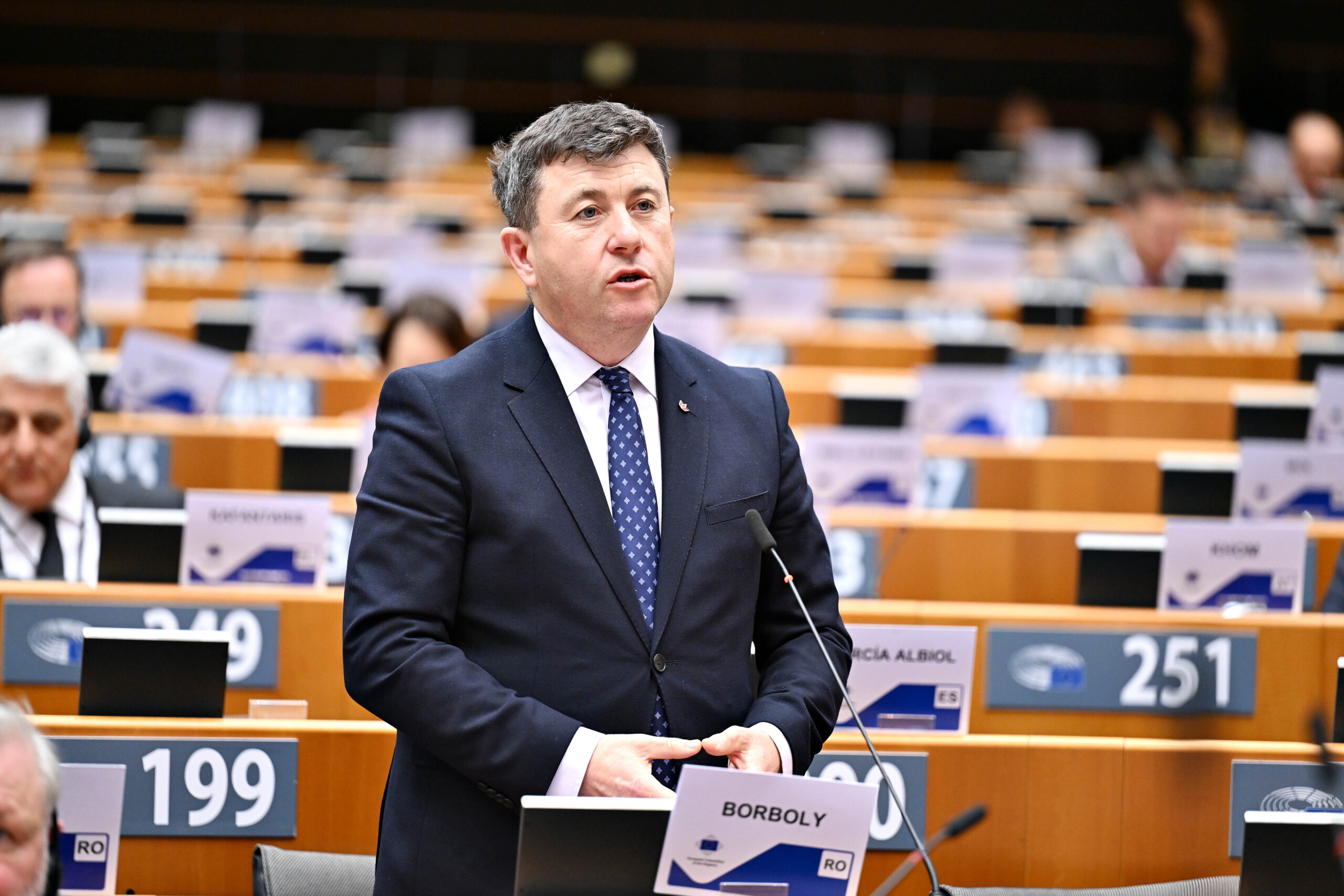
Brussels, 4 March 2026 – Borboly Csaba, Vice President of the Harghita County Council, spoke at the plenary session of the European Committee of the Regions (CoR) during the debate on the opinion concerning the European Union’s Water Resilience Strategy. Jessika Roswall, European Commissioner for Environment, Water Resilience and a Competitive Circular Economy, also delivered a statement at the session.
Why is this important for us in Harghita County?
Climate change is already making its impact felt in our mountainous region: streams have become more unpredictable, sudden floods and periods of drought are increasingly frequent, and forests and wetlands require stronger protection. The Carpathians are often called Romania’s “water tower” – what happens here, at the source regions, determines water security in the lowlands and influences the food, energy and climate security of the entire country and the wider region.
That is why it matters whether mountainous areas are included in the EU’s water protection strategy. In his intervention, Borboly Csaba warned that if mountains are left out, the risks increase for everyone.
What are we asking from Brussels?
Borboly Csaba submitted five amendments to the CoR opinion on water resilience, each aimed at strengthening the role of mountainous regions, biodiversity and local communities:
Recognition of water towers: including the strategic role of the Carpathians and other European mountain regions in the strategy.
Living laboratories: regions should serve as testing grounds for nature-based solutions and community-based water management.
Local monitoring: open data platforms, hydrometeorological networks, and school- and community-based measurements to strengthen local resilience.
Restoration of peatlands and wetlands: restoring mountain riparian forests and peatlands, and recognizing the role of beavers as natural “water engineers.”
Local water committees: bringing together municipalities, farmers, forest owners, civil society and young people in “One Water” platforms.
What EU funds and programs are coming?
The debate in Brussels is not merely theoretical: the European Commission’s Water Resilience Strategy, adopted in June 2025, contains more than 50 concrete measures to be implemented by 2030. The most important for mountainous regions include:
European Investment Bank (EIB) – €15 billion between 2025–2027 for water protection projects, including nature-based solutions. A new Sustainable Water Advisory Service will also support project preparation.
Water Resilience Investment Accelerator – 20 pilot projects focusing on natural water retention and water efficiency, involving local investors and solution providers and building on Living Lab networks.
Sponge Facility – a coordinated EU initiative to increase natural water retention, documenting “sponge measures” and sharing best practices.
LIFE Programme – the largest LIFE project ever (LIFE HumedalES, €160 million) is restoring wetlands in Spain with 40 partners, demonstrating that our region could also apply for projects of similar scale.
National Nature Restoration Plans – every Member State must submit a National Restoration Plan by September 2026 with binding targets for restoring wetlands, peatlands and rivers. Romania is preparing its plan – the question is whether the Carpathian mountain region will be included.
The next EU budget (MFF 2028–2034) – preparations are already underway, and the level of funding for water protection within cohesion policy and other funds is being decided now.
What should we do locally in Harghita County?
European funds and programs will only reach us if we prepare for them. This requires concrete local steps:
Harghita County Council should allocate resources for preparing water protection and nature restoration projects in each micro-region. EU funding programs (LIFE, cohesion funds, EIB programs) require local co-financing and project planning.
Mayors, landowners and farmers must cooperate. The conference in Miercurea Ciuc showed that without a shared commitment and a unified regional vision, everyone acts separately. The “local water committees” proposed by Borboly Csaba could provide this coordination.
Prepare for the National Restoration Plan. Romania must submit it by September 2026. If the Carpathian mountain region is not included among the priority areas, we may lose EU funding opportunities for decades. Lobbying efforts in Bucharest are therefore essential.
Apply for LIFE and EIB programs. The LIFE 2025–2027 work programme explicitly supports climate adaptation, drought and flood management, and water quality improvements. Projects from Harghita County can also apply – with proper professional preparation and partnerships.
Monitoring and data collection. Open data platforms, local hydrometeorological networks and community monitoring are needed. These data are not only valuable scientifically but are also essential for supporting funding applications.
The Miercurea Ciuc conference as a starting point
In November 2025, the “Mountain Water Resilience” conference was held at the Research and Development Institute for Wildlife Management and Mountain Resources in Miercurea Ciuc, with more than sixty participants. Kata Tüttő, President of the European Committee of the Regions, attended in person and expressed her support for the region’s proposals.
Researchers, local government leaders, farmers and young people jointly developed recommendations for sustainable water management in mountain areas.
The closing message of the conference was clear: water resilience does not begin in Brussels, but where the streams originate.
What is the next step?
The vote in Brussels has taken place. The Committee of the Regions’ opinion will now go to the European Commission and the European Parliament. But the work continues here, in the micro-regions of Harghita County: we must work together to ensure that mountain regions are not left out of the next EU budget – and that the funding truly reaches the streams, the springs and the communities living here.
Borboly Csaba – Vice President of the Harghita County Council, member of the European Committee of the Regions, and Ambassador of the European Climate Pact.