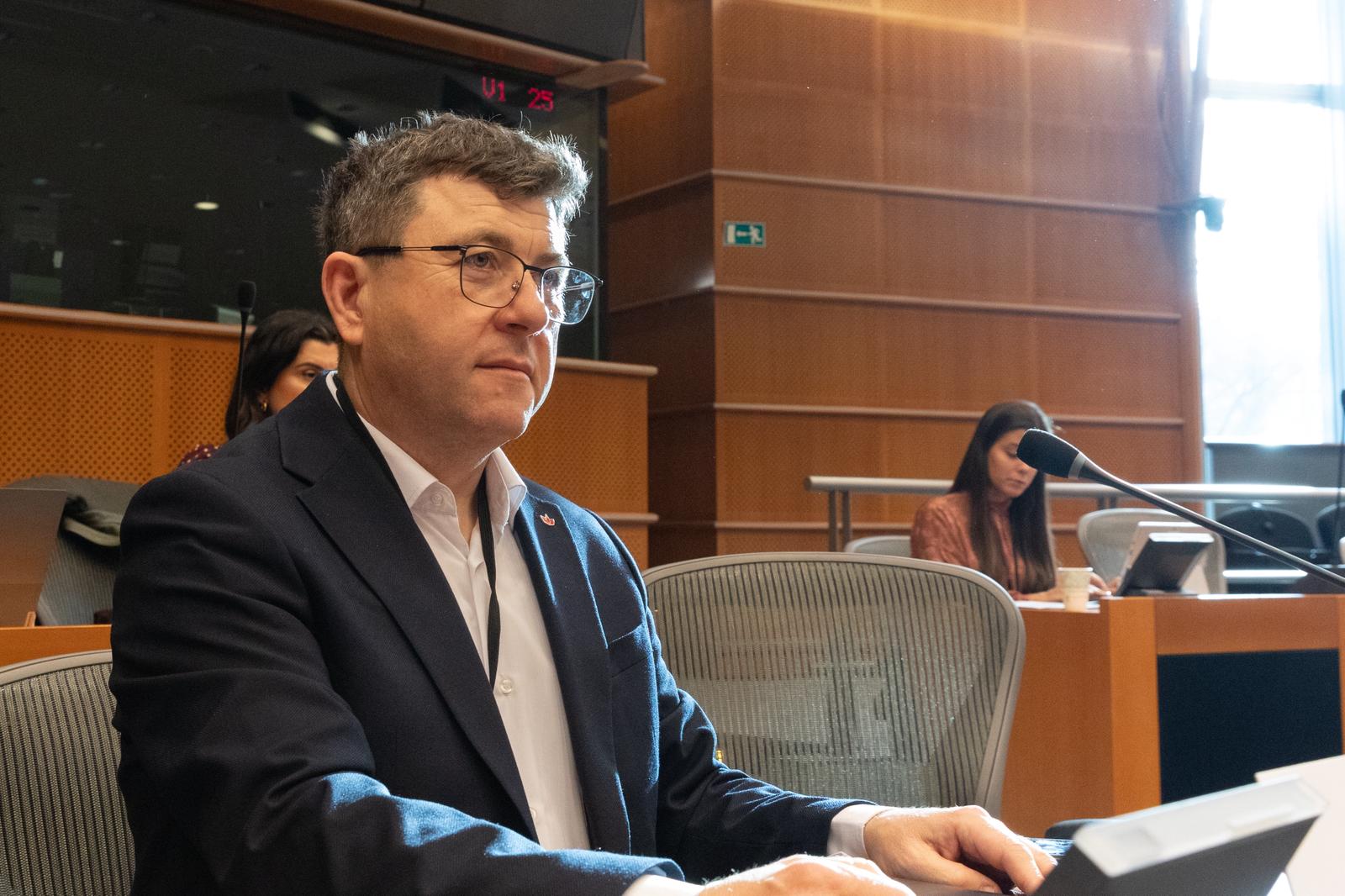
Csaba Borboly at the European Parliament on AgoraEU Media Funding: “Where Local Media Disappears, Democracy Dies in Silence”
Brussels, 26 February 2026 – Csaba Borboly, Vice-President of Harghita County Council and rapporteur of the European Committee of the Regions (CoR), delivered a keynote address today at the European Parliament’s joint CULT-LIBE committee stakeholder consultation on the media chapter of the AgoraEU programme. The three-hour expert session brought together Europe’s most significant media industry and press freedom organisations – and the future of local, rural media was at the centre of the debate.
Why Does This Meeting Matter?
AgoraEU is the European Union’s major new programme for the 2028–2034 period, merging the current Creative Europe and CERV (Citizens, Equality, Rights and Values) programmes into a single framework with a total budget of approximately €8.58 billion. The programme is built on three pillars: Culture+, Media+, and Democratic Participation. The Media+ pillar, with a budget of around €3.2 billion, will support European journalism, the protection of media pluralism, and the fight against disinformation.
Today’s consultation was a joint event of the EP’s two responsible committees – Culture (CULT) and Civil Liberties (LIBE) – organised by Co-Rapporteurs Emma Rafowicz (S&D) and Alice Kuhnke (Greens/EFA). The debate focused on the programme’s news media chapter: who should receive support, how to protect journalists, and how to address the growing phenomenon of “media deserts” across Europe.
Who Was Present? Europe’s Leading Media Organisations
Csaba Borboly opened the expert debate as the sole invited keynote speaker from the European Committee of the Regions, immediately following the introduction by the EP Co-Rapporteurs. Nine major European organisations then took the floor, collectively covering virtually the entire spectrum of Europe’s media industry and press freedom landscape:
- EMMA / ENPA (European Magazine Media Association / European Newspaper Publishers’ Association) – represented by Ariane Carre. ENPA is Europe’s largest newspaper publishers’ association, representing the print and digital press in 14 countries.
- AER (Association of European Radios) – Francesca Fabbri. The organisation representing European commercial radio broadcasters.
- ACT (Association of Commercial Television and Video on Demand) – Erard Gilles. The alliance of commercial television and video-on-demand services.
- EBU (European Broadcasting Union) – Wouter Gekiere. The European Broadcasting Union, representing public service media across Europe.
- News Media Europe – Wout van Wijk. The European organisation of news media publishers.
- Centre for Sustainable Media – David Kardos. An organisation researching sustainable media models.
- EU DisinfoLab – Joseph McNamee. One of the EU’s most prominent disinformation research centres, dedicated to uncovering online manipulation and protecting the information ecosystem.
- European Federation of Journalists (EFJ) – Rebecca Bonello Ghio. Europe’s largest journalists’ organisation, representing approximately 320,000 journalists in 46 countries and working to defend press freedom, social rights and media pluralism.
- Reporters Without Borders (RSF) – Julie Majerczak. RSF defends the right to free and reliable information worldwide and regularly documents violations of press freedom.
What Did Csaba Borboly Say?
The rapporteur spoke from personal experience: he comes from Harghita County, a Hungarian-speaking minority region in Romania, where the survival of local media is a daily struggle.
“I know what it means when local media disappears. Communities lose their voice. Citizens lose access to information in their own language. Democracy weakens – silently, village by village,” he said in his address.
He presented the CoR opinion – adopted unanimously by the SEDEC committee – in five concrete proposals:
- Dedicated Funding for Local and Regional Media
AgoraEU’s open calls naturally favour large, international media players in major cities. Borboly called for the programme to provide separate, territorially balanced funding for public service broadcasting, independent journalism and print media in smaller towns and rural regions where market size does not allow for commercial sustainability.
- Journalist Protection at Local Level
National-level protection mechanisms do not automatically reach a rural journalist investigating local corruption in a small town. The rapporteur asked the EP to ensure that AgoraEU explicitly extends protection tools to journalists working at local and regional level.
- Measurable Territorial Balance
The CoR opinion calls for specific monitoring indicators disaggregated by urban/rural areas, by region, and by disadvantage index, to track the distribution of funding. “If we do not measure what we promise, we cannot correct imbalances,” Borboly said.
- Reform of the Evaluation System
The rapporteur called for evaluation panels to include experts in rural development and regional innovation, for evaluators to be geographically proportionate across the EU, and for regular reviews to detect systematic bias.
- Realistic Access for Small Actors
Simplified grant formats, cascade grants, mentoring, local contact points and a maximum 10% own contribution – which can be covered through national, regional or local co-financing. “A talented local journalist or a community radio should not be excluded because they cannot navigate a 50-page application,” he stressed.
The rapporteur also made a crucial distinction: news media is not the same as audiovisual. News and film have fundamentally different logics, markets and needs. The news strand should be clearly separated in the programme design and linked to education – media literacy partnerships with schools, libraries and civil society, especially in rural communities.
Why Do We Need Local Media? Why Is the Internet Not Enough?
This is not an abstract policy debate from Brussels. It affects daily life – in Harghita County, in Szeklerland, and in every region where local media is fighting to survive.
Media Deserts Are Spreading Across Europe
A comprehensive study by the Centre for Media Pluralism and Media Freedom (CMPF), covering all 27 EU Member States, found that the local media crisis is spreading across Europe. In several countries, rural areas have no local media at all. In five additional countries, rural coverage falls into the “high risk” category. The number of local journalists is declining EU-wide, newsrooms are being centralised in capital cities, and “desk journalism” – reporting done from offices via phone and internet – is replacing fieldwork.
The Situation in Romania
In Romania, the situation is particularly severe. There are virtually no direct state subsidies for local media, and the only indirect support – reduced VAT on printed press – has almost no effect because there are barely any printed publications left. Google and Facebook absorb approximately two-thirds of Romania’s online advertising market, with the remainder going largely to Bucharest and major cities. Hardly anything reaches rural and minority regions.
In Harghita County, sustaining Hungarian-language media is an additional challenge: national public service radio broadcasts almost exclusively in Romanian, and minority-language news services barely exist in the private sector either.
When There Is No Local Media, Rumours Fill the Void
We see this at home too: whether the topic is tax policy or any other issue that suddenly erupts in public debate, people rely on social media and unverified sources. Without a local journalist, there is nobody to fact-check, verify, or provide context. According to EU surveys, over 90% of respondents consider disinformation and social media manipulation one of the greatest threats to democracy.
Local media is not a luxury – it is democracy’s infrastructure. The trusted local journalist is someone the community knows, whose information can be verified. Where this is missing, disinformation spreads unchecked.
The Minority and Rural Dimension
For minority communities – such as the Szekler Hungarians – local, mother-tongue media is not merely an information tool: it is a fundamental pillar of identity, community cohesion and youth retention. If young people can only access media in a foreign language from distant big cities, they lose their connection to their community. AgoraEU must therefore explicitly protect linguistic diversity and ensure that minority-language cultural and media actors can compete on equal terms.
What Comes Next?
The EP CULT committee’s draft report is expected in June 2026, with the amendment deadline set for 11 June and the committee vote expected in October. The Committee of the Regions’ opinion will be voted at the plenary session on 6–7 May 2026. Rapporteur Csaba Borboly will continue consultations with MEPs and stakeholder organisations to ensure that territorial safeguards – protection of local media, rural access and the minority dimension – are embedded in the final legislative text.
“I am not asking for special treatment for any region. I am asking for equal opportunity – for the journalist in Harghita, for the community radio in rural Andalusia, for the local newspaper in a Finnish border town. AgoraEU must work everywhere – not only where the market already works,” Borboly concluded.