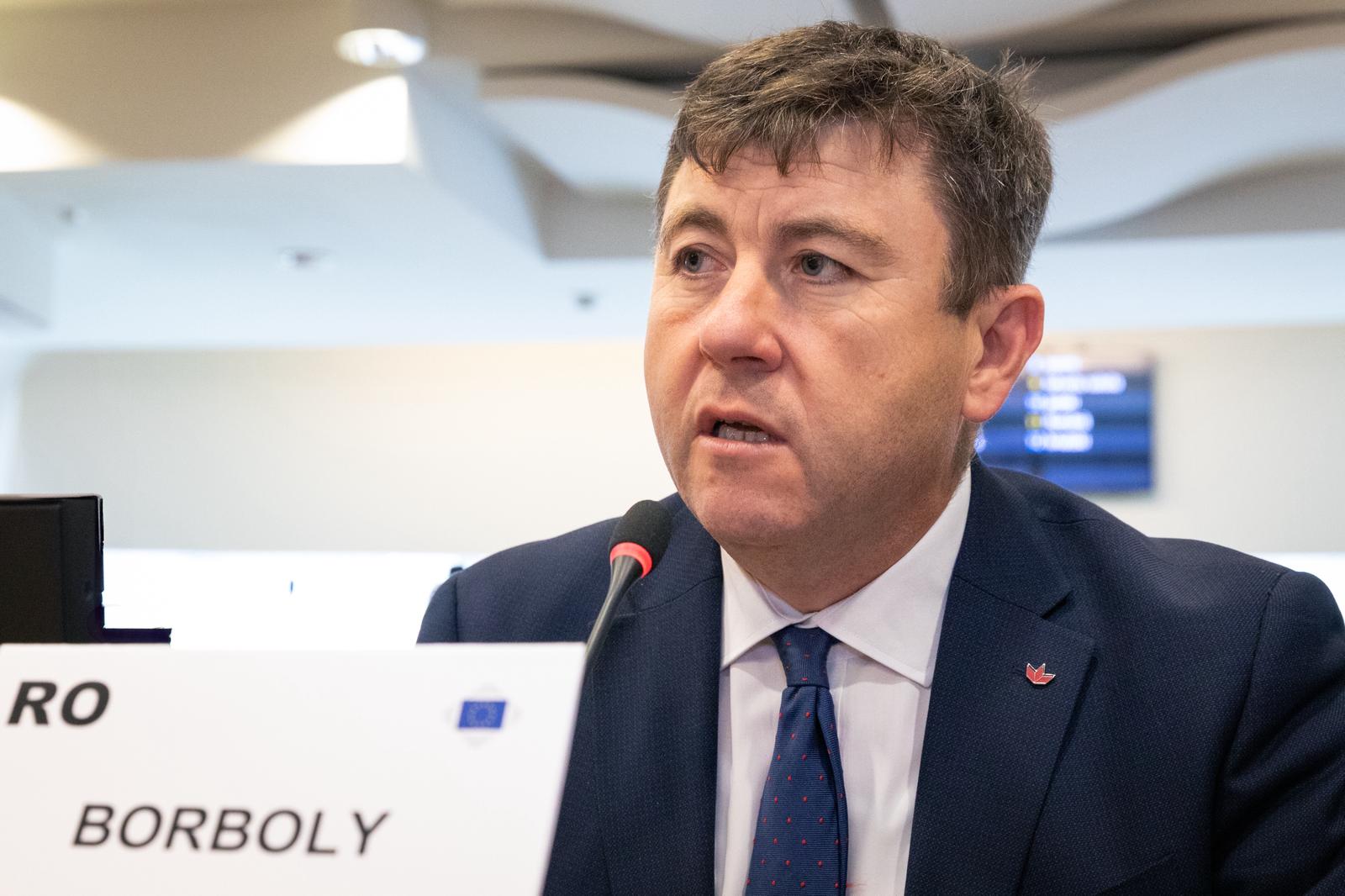
Csaba Borboly’s Speech at the ENVE Committee: Harghita County and the Large Carnivore Issue in Brussels
Introduction
On December 5, 2025, in Brussels, at the meeting of the Environment, Climate Change, and Energy (ENVE) Committee of the European Committee of the Regions, Csaba Borboly, Vice President of Harghita County Council, spoke firmly on brown bear management and the European-level regulation of large carnivores. His speech clearly indicated that mountainous regions are not only local stakeholders but also actively engage at the European political level in balancing human safety, rural livelihoods, and biodiversity protection. As Vice President of Harghita County, Csaba Borboly consistently supports legally grounded and politically ambitious solutions for managing large carnivores.
The event brought together representatives from several European mountainous regions facing challenges related to bears and other large carnivores. Decision-makers, mountain livestock farmers, tourism, and agricultural stakeholders from regions where bear presence already has significant economic and social impacts were invited to the first European meeting in Foix, with the aim of creating a common European action framework.
Brown Bear Meeting: A European Mountain Alliance for Large Carnivore Management
The Brussels intervention is closely linked to the Brown Bear Meeting in France, where representatives of mountainous regions – including Csaba Borboly – established a common European forum on coexistence with large carnivores. The meeting was organized by the “Parliament for the Future of Mountains” (PAM09) in Ariège and the French DAATE (Directorate for Territorial Attractiveness, Planning and Environment), under the professional coordination of Tim Juvany.
Key political and professional actors involved:
- Christine Tequi – President of Ariège Department
- Philippe Lacube – President of the Ariège Agricultural Chamber
- Alain Servat – President of the Ariège Pastoral Federation
- Guillaume Agéde – Policy Advisor on Large Carnivores at the European Association for Hunting and Nature Conservation
- Tim Juvany – PAM09 Bear Project Coordinator
- Farmers, tourism, and agricultural stakeholders from multiple European regions
As part of the process, a draft European charter was prepared, to which partners – including Harghita County – can submit written proposals. The charter reflects a common position on protecting mountain communities and managing large carnivores. The French partners specifically designated Csaba Borboly to receive European predator data and utilize it at the professional and political level, reinforcing his leadership role in representing mountainous regions.
Legal Foundation and EU Frameworks
Harghita County Large Carnivore Platform
Harghita County’s large carnivore action and implementation plan is based on EU nature conservation legislation – the Habitats Directive (92/43/EEC) and the Birds Directive (2009/147/EC) – as well as the European Large Carnivore Platform’s recommendations. The plan emphasizes participatory, evidence-based decision-making and was developed with support from the European Commission under Service Contract No. 09.0201/2023/907799/SER/ENV.D.3.
Current Situation and Overpopulation Problem
The document notes that Harghita County hosts one of Europe’s largest brown bear populations. In recent years, conflicts between humans and wildlife have increased in both frequency and severity:
- Increasing agricultural damage
- Rising number of human injuries
- Growing concerns about public safety
Scientific observations and long-term data indicate that the bear population significantly exceeds the region’s ecological and social carrying capacity. The lack of consistent population management has led to overpopulation, which is the direct cause of most human–wildlife conflicts.
Legislative Proposals in the European Charter
The draft charter prepared by French partners proposes several key amendments under Article 16 of the Habitats Directive:
- Reclassification of Brown Bear Protection Level
The charter proposes moving the brown bear from the “strictly protected” category to the “protected” category in EU legislation (Habitats Directive, Bern Convention). - Common Protocol for Managing Dangerous Individuals
o Developing a shared operational framework for identifying, classifying, and managing “dangerous” bears
o Transparency of population data, individual identification, and bear localization
o Strengthening analytical capacity and rapid DNA testing for problem bears
o Systematic involvement of local stakeholders in protocol development
- Legal Recognition of Self-Defense
o Permitting the use of 500 ml pepper spray
o Allowing mountain specialists to carry firearms
o Legal framework for deterrent devices
o Specialized training for cattle farmers, public officials, and authorized citizens
EU Competence and ENVE Role
ENVE Committee findings
The ENVE Committee and the EU Biodiversity Strategy emphasize that large carnivore management can only succeed through multi-level governance, involving local and regional authorities, scientific approaches, and appropriate EU legal frameworks. This principle is not just a recommendation but part of the established EU competence.
Harghita County’s Call for European-Level Action
Harghita’s action plan explicitly requests European interventions:
- Legislative reforms in the Habitats Directive – more flexible protection levels and derogation rules
- New EU financial mechanism – a dedicated solidarity fund in the 2028–2034 Multiannual Financial Framework
- Fair compensation system – EU-funded, reflecting real economic and genetic value
- Support for prevention and management – EU financial tools for wildlife management, infrastructure, and rapid response
Message of the ENVE Intervention
Csaba Borboly’s speech in Brussels combined local experience with highlighting EU competences:
- Need to review species protection legislation
- Possibility to make derogation systems more flexible
- Creation of a fair, EU-funded compensation mechanism
- Implementation of multi-level governance principles
Harghita County and Csaba Borboly’s Role
Regional Large Carnivore Platform – A Model
Harghita’s Regional Large Carnivore Platform serves as a model in the EU by:
- Managing human safety, rural livelihoods, and biodiversity protection in a unified, transparent governance framework
- Using problem mapping and goal analysis
- Applying multi-criteria ranking
- Developing consensus-based measures
- Aligning with the EU’s evidence-based, participatory approach
Platform participants include:
- Local and county authorities
- Wildlife and forestry management representatives
- Agricultural experts
- Scientific institutions
- NGOs
Csaba Borboly’s Role
- National – representing the interests of Hungarian mountain regions as Vice President of Harghita County Council
- Regional – active in the European network of large carnivore platforms
- European – designated rapporteur in the European Committee of the Regions by French partners
- International – actively shaping the political and professional discourse on European large carnivore management
Strengthening European Solidarity
Today’s Brussels intervention gives new momentum to this process, demonstrating that:
- Csaba Borboly fights consistently both at home and in Brussels and across Europe
- For safe human–large carnivore coexistence
- For evidence-based wildlife management
- For strengthening European solidarity and shared responsibility
Strategic Goals and Progress
Key objectives of Harghita County Action and Implementation Plan:
- Safety – protecting human life, rapid and professional response to conflict situations
- Resilient Communities – strengthening rural populations, fair compensation for victims
- Real Wildlife Management – active, science-based population control to restore ecological balance
- Political Flexibility – reviewing protection levels and management rules in areas with overpopulation
- Transparency and Cooperation – building trust through open data, partnerships, and ongoing dialogue
Concrete measures in the region:
- Education and Awareness – school programs, community training, BearSmart Harghita initiative
- Prevention and Safety Systems – bear-proof infrastructure, electric fences, guard dogs, rapid alert protocols
- Damage Assessment and Compensation – independent expert system, digital technologies, fair compensation
- Population and Habitat Management – science-based quotas, continuous monitoring
- Data Transparency and Governance – public data platform, annual reporting, certified decision-making
- Institutional Cooperation – coordination at local, county, national, and EU levels
European Perspective and Continuation of French Initiative
Draft European Charter:
- Participating regions receive the draft charter and can submit written proposals
- Videoconferences are organized with representatives from different countries and counties
- Tim Juvany collects predation data from all involved regions
- Data is sent to Csaba Borboly
- Csaba Borboly utilizes the information in European-level professional and political work
Long-Term European Cooperation
The plan aims to maintain sustainable European collaboration:
- Regular consultation among partners
- Data and best practice exchange
- Joint action to protect the interests of mountainous regions
Conclusion: The Message
Csaba Borboly’s speech in Brussels demonstrates that the large carnivore issue is not only local or national but present on the EU political agenda. Harghita County is not a passive observer but an active shaper of European large carnivore policy.
The message is clear: safety, science, and real wildlife management. Coexistence cannot rely solely on protection – active, science-based management, a fair support system, and coordinated governance are essential.
As Vice President of Harghita County Council, Csaba Borboly is committed to building a model where humans, nature, and rural life cooperate responsibly, transparently, and sustainably – for the shared future of Romania and Europe.