I chaired the second meeting of the European Committee of the Regions Working Group on Bosnia and Herzegovina in Brčko – new alliances in the Western Balkans, strengthening ties with the Carpathian Basin
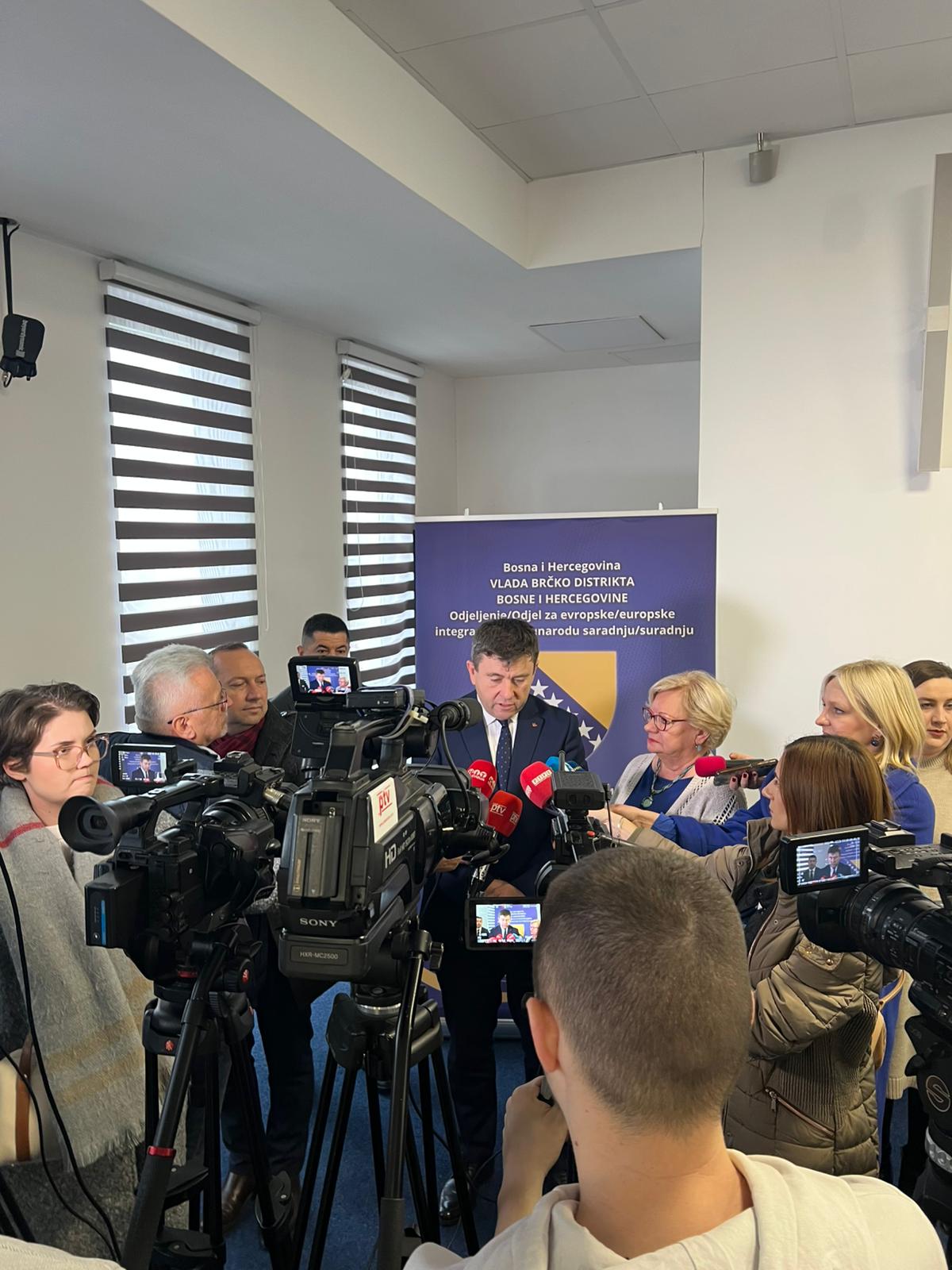
On 2 December 2025, in the city of Brčko, one of Bosnia and Herzegovina’s most important administrative centres, I chaired the second meeting of the European Committee of the Regions’ Working Group on Bosnia and Herzegovina. The meeting brought together representatives of the local government associations from both entities, Brčko District leaders, representatives of the Ministry of Foreign Affairs of Bosnia and Herzegovina, experts from the EU Delegation, as well as leaders from SALAR International and the Council of Europe.
This was the first time that the Working Group held a session in Bosnia and Herzegovina, and the choice of venue was no coincidence: Brčko is widely considered the most successful interethnic model in the country.
The objective of the CoR Working Group is to involve local and regional actors in the EU accession process, and to support trust-building and capacity-strengthening efforts.
Coming from Harghita County, many challenges felt familiar – these experiences are now valuable for Bosnia and Herzegovina
In my opening speech, I highlighted:
“I come from Harghita County, where 86% of the population is Hungarian. For 16 years, I led a region that is linguistically sensitive and culturally diverse. Many challenges you are facing here are very familiar to me.”
There was strong interest in Harghita’s experience – many participants said that decentralisation, language rights, partnership programmes, and local development models are particularly relevant for their own context.
Strong bilateral discussions – new connections emerging across the Western Balkans
In addition to the plenary session, I held several bilateral meetings:
- with the Mayor of Brčko and the President of the District Assembly,
- with the Ambassador of the Ministry of Foreign Affairs of Bosnia and Herzegovina,
- with the leaders of the local government associations of both entities,
- with senior representatives of the EU Delegation,
- with experts from SALAR International.
One thing became clear:
Bosnia and Herzegovina considers Harghita County and the Hungarian local government sphere valuable partners at all levels.
The shared conclusion of our discussions:
“Pre-accession funds work best when they support as many concrete partnerships as possible between local municipalities.”
This is a major opportunity for Harghita County and for local governments across the Carpathian Basin.
Why does this matter for us—Harghita County and the regions of the Carpathian Basin?
The work of this Working Group is a strategic investment for our wider region:
- We are building alliances now with Western Balkan partners who, within a few years, will sit at the EU decision-making table.
- If Bosnia and Herzegovina joins the EU, it matters whether they arrive as allies or as strangers.
- The Working Group strengthens Hungarian–Hungarian cooperation as well, since many leaders referred to examples from the Carpathian Basin.
- Historically, this also continues the legacy of cooperation from the Austro-Hungarian Monarchy: shared infrastructure, cross-border development, and interregional partnerships.
Today’s meeting clearly showed that there is political will and openness for such partnerships.
Local reactions: Brčko’s media highlighted the importance of the session
Local media reported extensively on the event. According to coverage,
the session of the CoR Working Group in Brčko represents an important step toward involving local actors in the European integration process.
The article also noted that local leaders see Brčko as an exemplary model of cooperation and peaceful coexistence.
Selected messages from the speakers – reinforcing the direction of today’s work
Siniša Milić, Mayor of Brčko:
“From a place of conflict, we have become a model. We are developing with energy and EU-funded projects, and we are open to learning.”
Deputy Ambassador Babajide, EU Delegation:
“There has been some progress, and the adoption of the Reform Agenda is an important milestone toward the EU.”
Milan Zečević, Association of Municipalities and Cities of Republika Srpska:
“We have the most complex system in Europe – our partners must understand this in order to work with us.”
Kenan Dautović, Association of Municipalities and Towns of the Federation of Bosnia and Herzegovina:
“Local governments are not secondary players; they are real actors in the accession process.”
Denisa Sarajlić, SALAR International:
“We have been here for 20 years – the local level must be involved, because they see the reality on the ground.”
Next step: elevating the Working Group to a legal body – establishing a JCC
One of the most important conclusions of the meeting was that the time has come to establish a Joint Consultative Committee (JCC), in which delegates from the municipalities of Bosnia and Herzegovina would participate as equal members, making decisions together with the CoR.
This would be a major step forward for:
- involving local actors,
- strengthening professional cooperation,
- supporting long-term European integration.
Conclusion: Brčko sent a strong message today – and we responded with an equally strong commitment
Today’s session proved that:
- there is willingness for reforms,
- there is demand for partnerships,
- there is space for joint projects,
- and there is a future for Bosnia–Hungary–EU cooperation.
This is why I continue this work as Chair,
and this is why it is important for Harghita County to remain present in this process.
The Working Group will continue its work – at an increasingly higher level and with even closer cooperation.
Brčko, 2 December 2025